
Best Newsletter
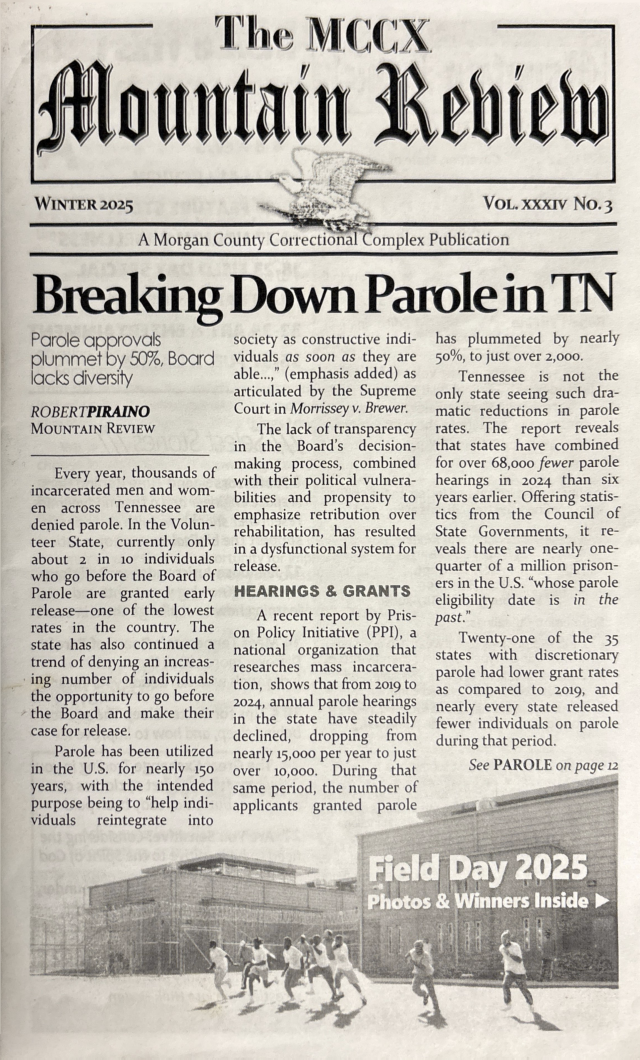
1st place: Mountain Review
The Mountain Review was established in 1987 in Morgan County Correctional Complex, a maximum-security facility in Tennessee. The Review has one staffer who serves as the editor-in-chief and does the reporting, layout, and printing by himself. The Review seeks to amplify the voices of those affected by the criminal legal system, while providing accurate, relevant information and constructive content to the incarcerated community and beyond.
Winning on breadth and accountability, our judges highlighted the Mountain Review’s use of documents, its Law Review section, From the Archives feature and the editor’s column in every issue as reasons for distinction.
Read the winning issues: Spring 2025, Summer 2025, Winter 2025
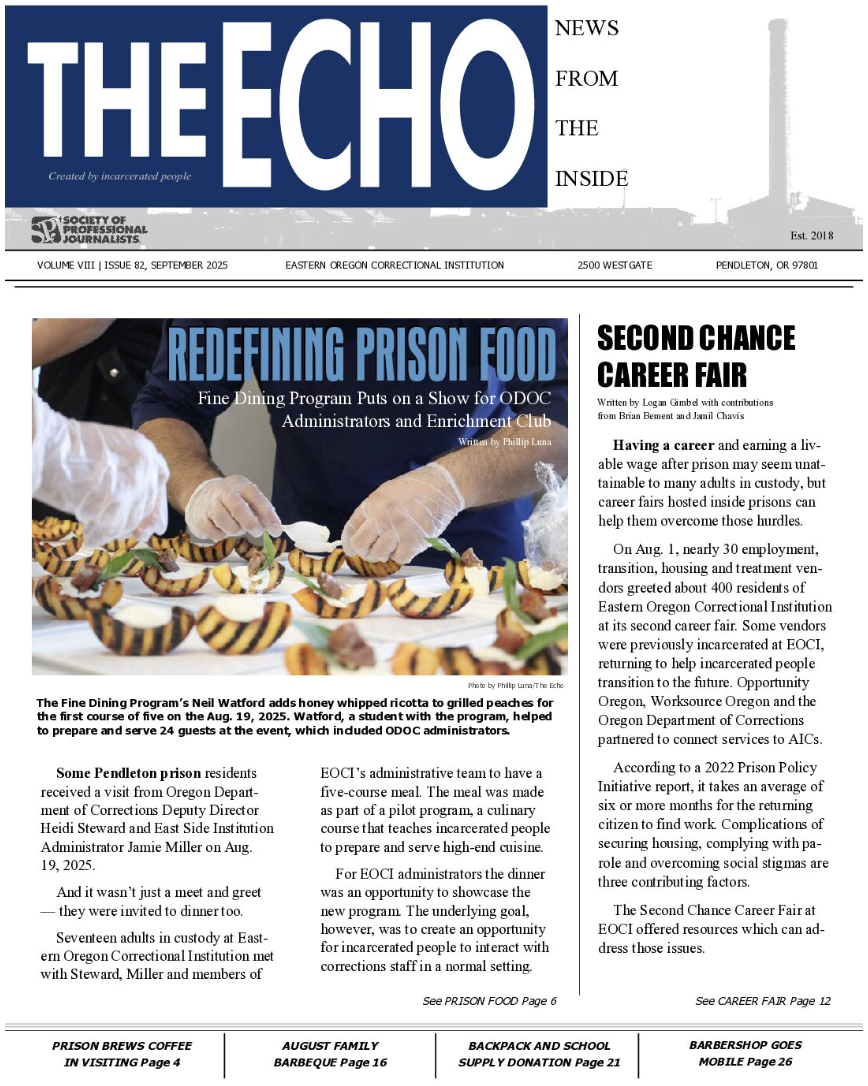
2nd place: The Echo
The Echo began publishing monthly newsletters out of Eastern Oregon Correctional Institution in 2018. Their mission is simple and straightforward: to serve the incarcerated community by providing monthly news and other important information, while highlighting the human experience in the carceral setting.
Read the newsletter: August 2025, Sept 2025, Nov 2025
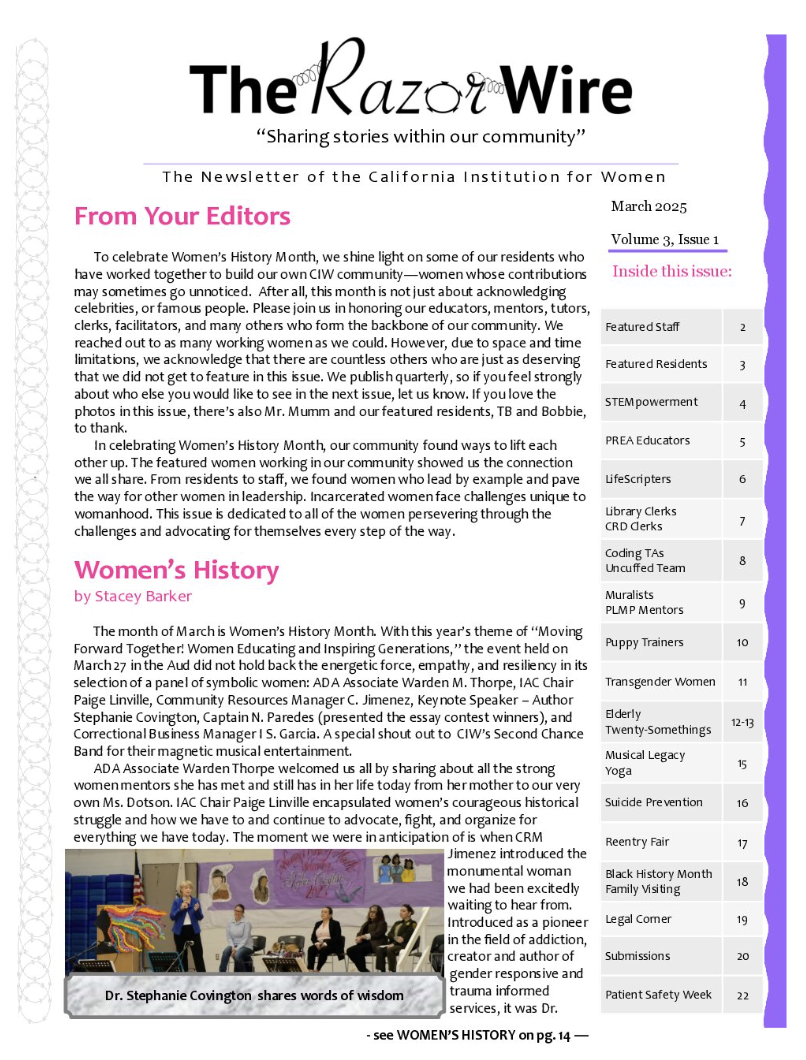
3rd place: The Razor Wire
Established in 2024, The Razor Wire is a quarterly newsletter produced by women incarcerated in the California Institution for Women. Their mission is to empower people inside women's prisons by utilizing diverse perspectives to inform about rehabilitation by and for incarcerated people.
Read the newsletter: March 2025, June 2025, Sept 2025
Best Newspaper
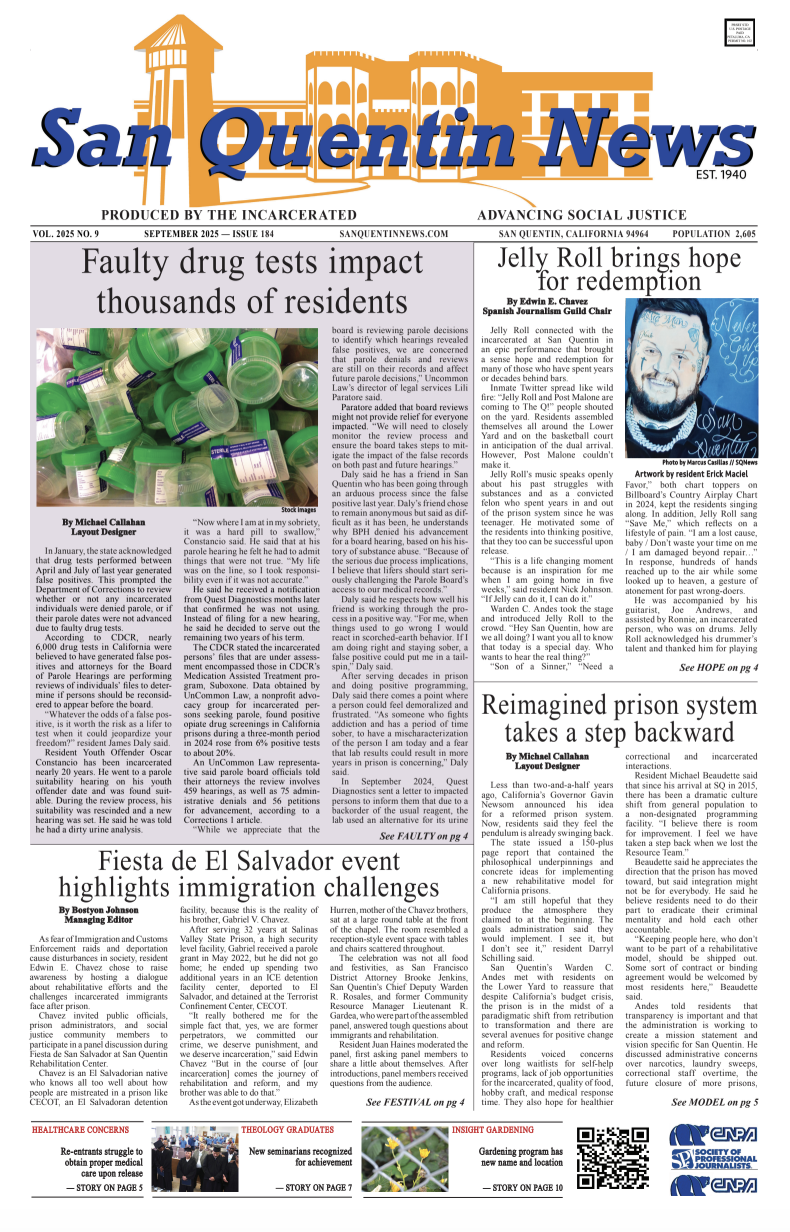
1st place: San Quentin News
Founded in 1940 and relaunched after a hiatus in 2008, San Quentin News is a publication produced entirely by individuals incarcerated in San Quentin Rehabilitation Center. In a 12-page monthly spread, the paper’s mission is to report stories that impact incarcerated people, both in their community and nationally.
Judges called this the only complete newspaper in the category, winning on breadth. San Quentin News offers news, opinion, and features with visible editorial judgment, sustained across issues.
Read the winning issues: May 2025, Sept 2025, Nov 2025
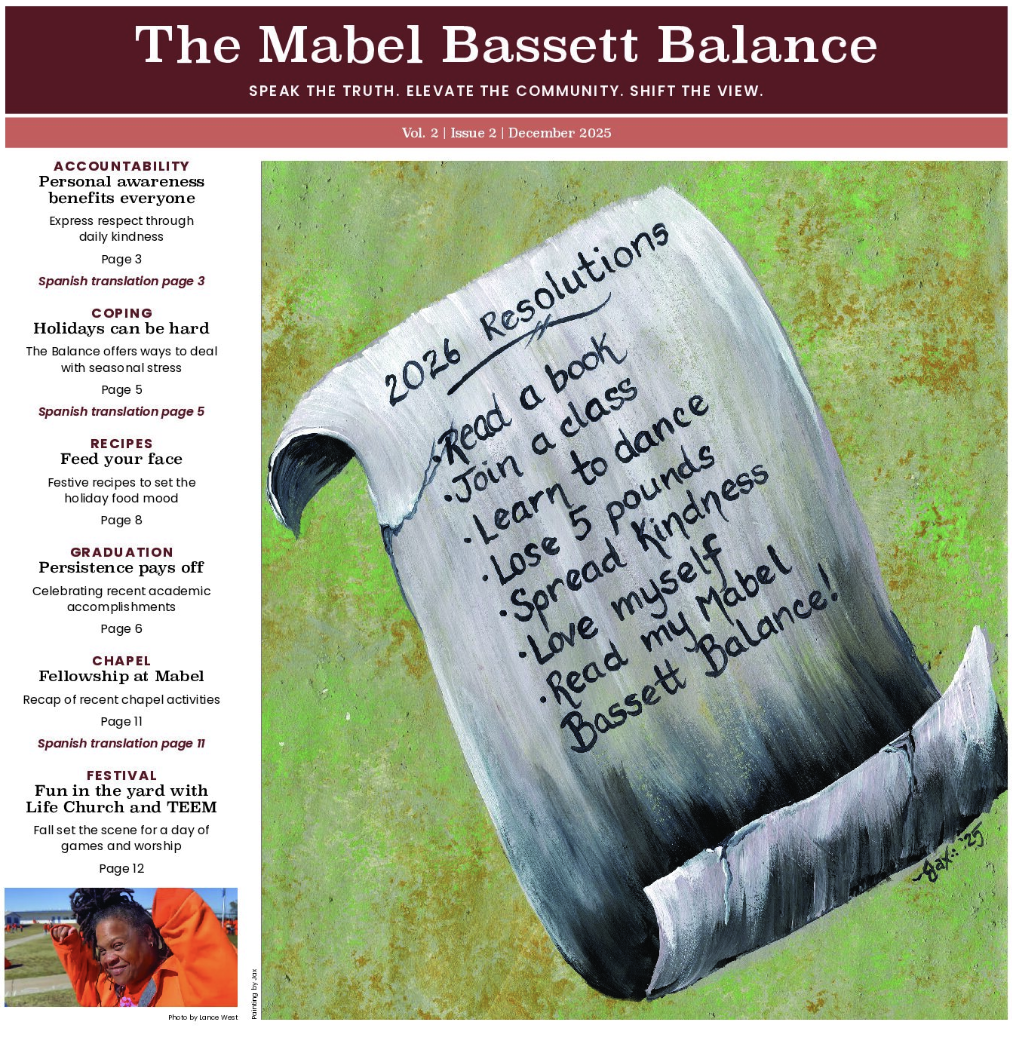
2nd place: The Mabel Balance Bassett
The Mabel Bassett Balance was created in 2024 as a small-town newspaper catering to readers inside and outside the razor wire. Its mission is to speak the truth, elevate the community, and shift the view—tenets that guide the development of stories and layout design. However, it is first and foremost a prison publication and privileges the experiences of Mabel residents, highlighting both challenges and experiences of joy. Mabel Bassett Correctional Center houses mostly residents with long sentences, including life with and without parole. In fact, some of our writers are serving life sentences. The newspaper captures the carceral realities at Mabel—it is a community forged by time—and strives to meet the needs of those living there together.
Read the winning issues: April 2025, Aug 2025, Dec 2025
Best Magazine
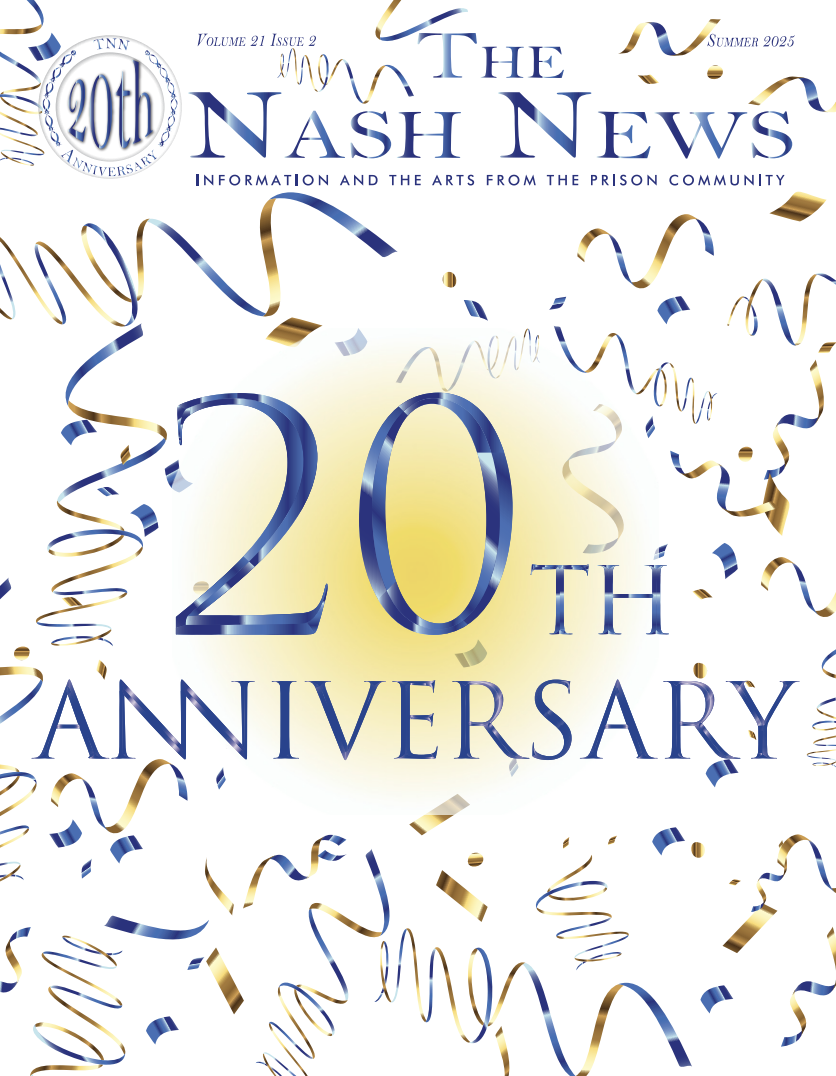
First place: The Nash News
The Nash News was founded out of Nash Correctional Institution in 2005 to provide timely and useful information to the population; offer a forum for discussion, dialogue, and creativity; encourage, give hope, and strengthen their community; and instill an appreciation for the written word.
As a magazine with a twenty-one-year mission restated and demonstrably met, The Nash News is planned, written, designed and printed entirely by incarcerated staff, with no outside hand in the production chain, which is a true accomplishment.
Read the magazine
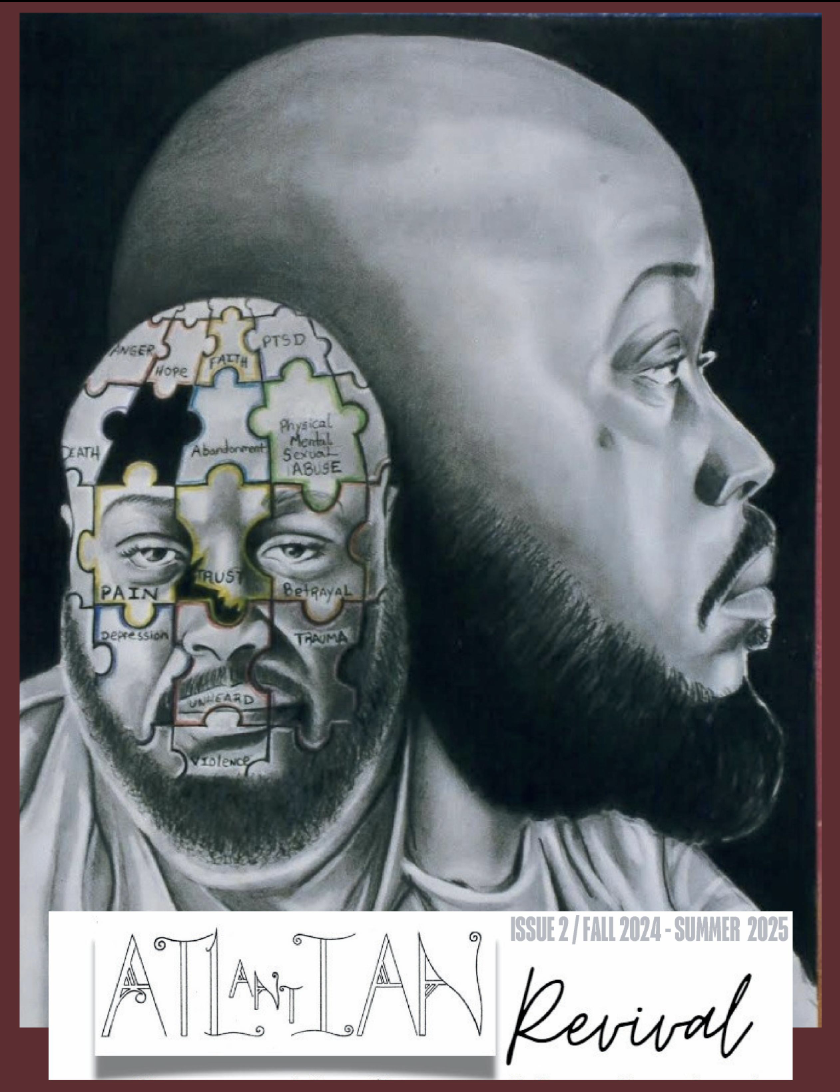
2nd place: Atlantian Revival
Atlantian Revival was established in 2024 in Federal Correctional Institution, Atlanta. The mission of the Atlantian Revival is to empower one another and to build solidarity by functioning as a central source of information, highlighting the humanitarian nature inherent in all of us, and above all, being of service and continuing to learn to better serve our community here at historic USP, now FCI, Atlanta.
Read the winning issues: Issue 2, Issue 3
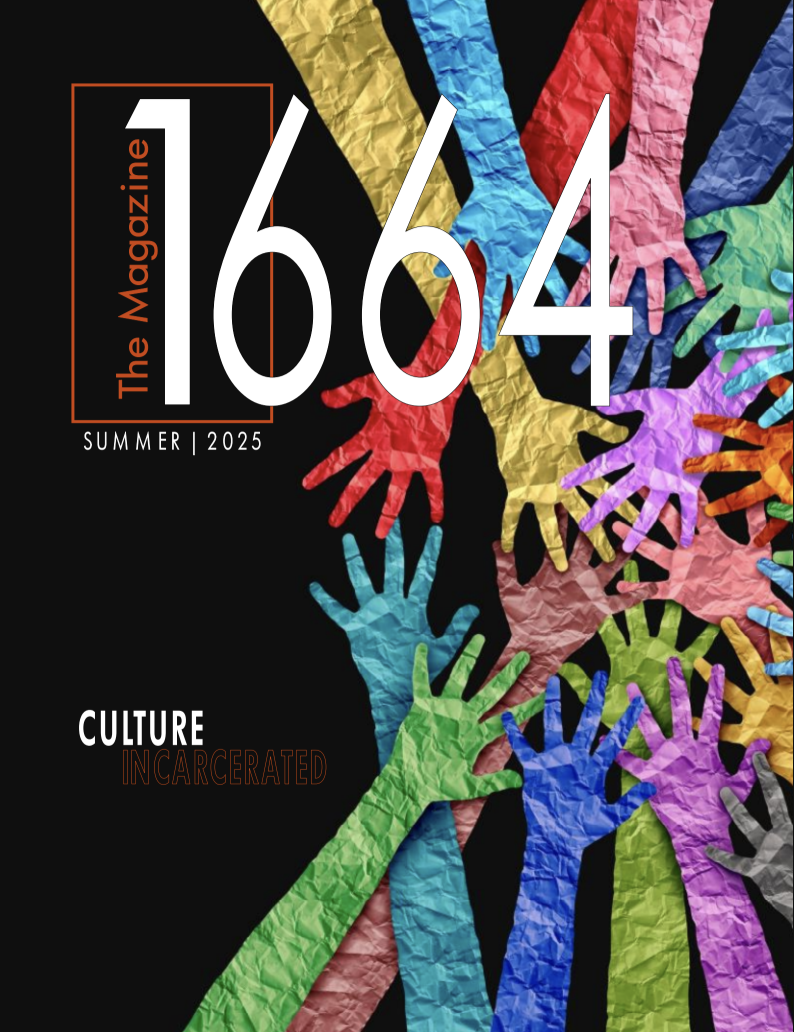
3rd place: 1664
1664 was established in Eastern Oregon Correctional Institution in February 2024. At that time, there were 1,664 state and federal prisons nationwide, incarcerating 1.9 million people. The mission of 1664 is to provide names and faces in place of these numbers and statistics — to celebrate humanity and recognize that every individual has a story.
Read the winning issue
Best Debut Publication
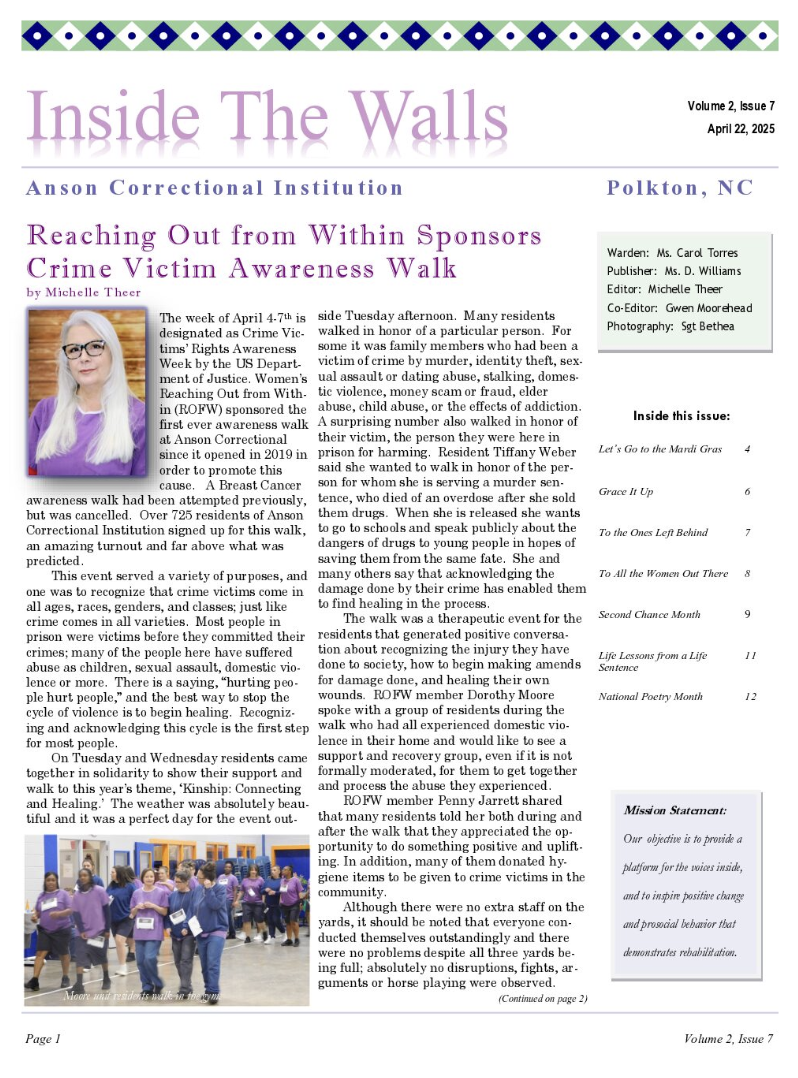
1st place: Inside The Walls
Inside The Walls was established in Fall of 2024 in North Carolina’s Anson Correctional Institution. Their objective is to provide a platform for the voices inside, and to inspire positive change and prosocial behavior that demonstrates rehabilitation. Their secondary goal is to share stories of incarcerated people and their lives inside in order to deepen understanding of their struggles and educate the public. They hope to break down stereotypes and build compassion for those in prison while empowering them to tell their story.
Praised for its clean layout and the diversity of resident voices, this issue wins for its strength in the service category. One judge particularly liked the “I wish I had a second chance to...” prompt, and singled out the “Reason for Avoidance" graphic as news readers can actually use.
Read the winning issues: Spring 2025, Fall 2025, Winter 2025
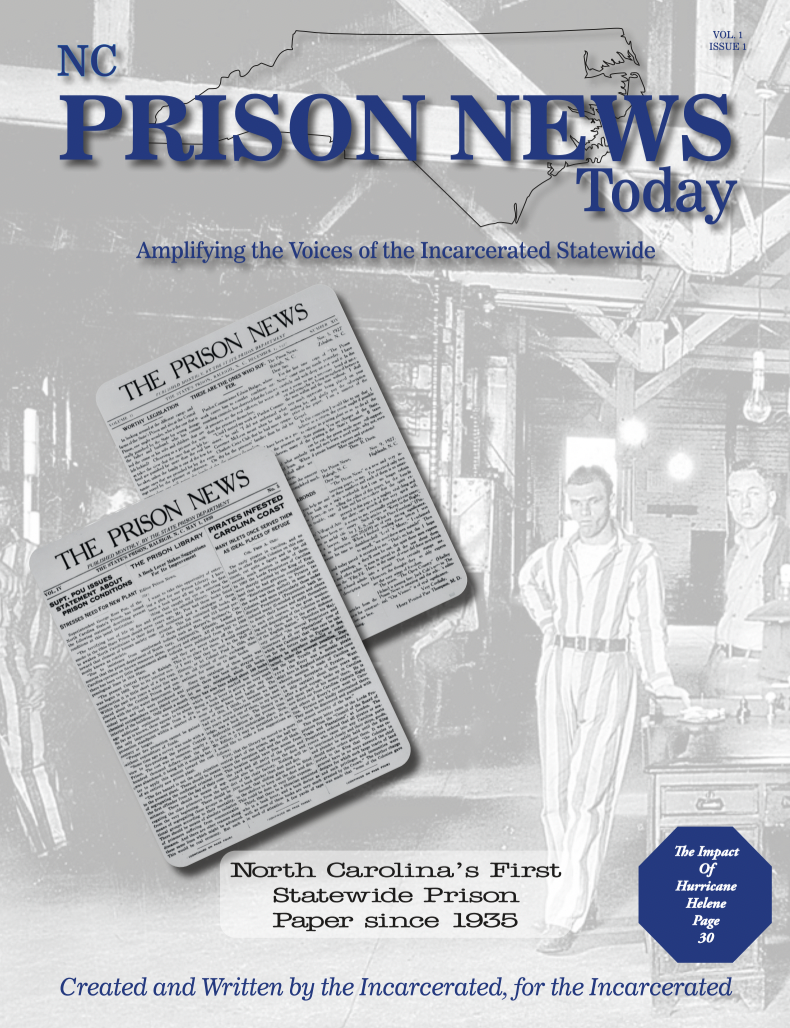
2nd place: NC Prison News Today
North Carolina Prison News Today (NCPNT) is a quarterly magazine established in 2024 through a partnership between Nash Correctional Institution, the North Carolina Department of Adult Correction, and the publication staff of The Nash News. By soliciting stories outside of Nash Correctional, NC Prison News Today aims to amplify the voices of the incarcerated statewide and offer a truthful alternative to the false narrative told by outside media about incarcerated people.
Read their stories
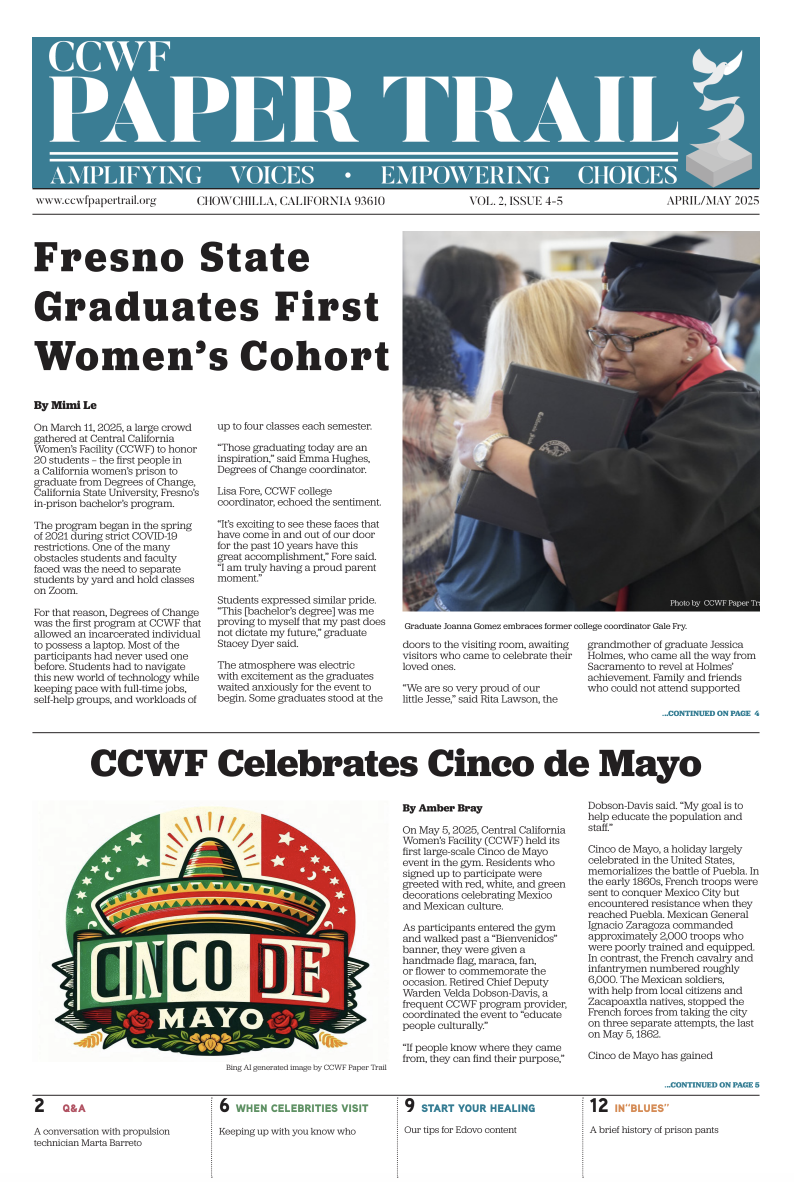
3rd place: CCWF Paper Trail
CCWF Paper Trail is a pioneering publication launched in 2024 to serve the largest women’s prison in the world. It engages with community, promotes hope, creates positive solutions, and amplifies voices rarely heard.
Read their stories
Best Opinion Story
Best Short-Form Reporting
Best Long-Form Reporting
Best Short-Form Feature
Best Long-Form Feature
Best Sports & Recreation Reporting
Best Visual Journalism
1st place: Overall issue design of The Nash News, 20th Anniversary Edition (Vol. 21 Issue 2)
In celebration of the publication’s 20th anniversary, The Nash News pulled out the stops for this colorful, visually exciting issue. Doubling both as a record of recent events as well as a volume of their own institutional history, the issue combines a timeline of accomplishments and thoughtful reflection on what their milestone means.
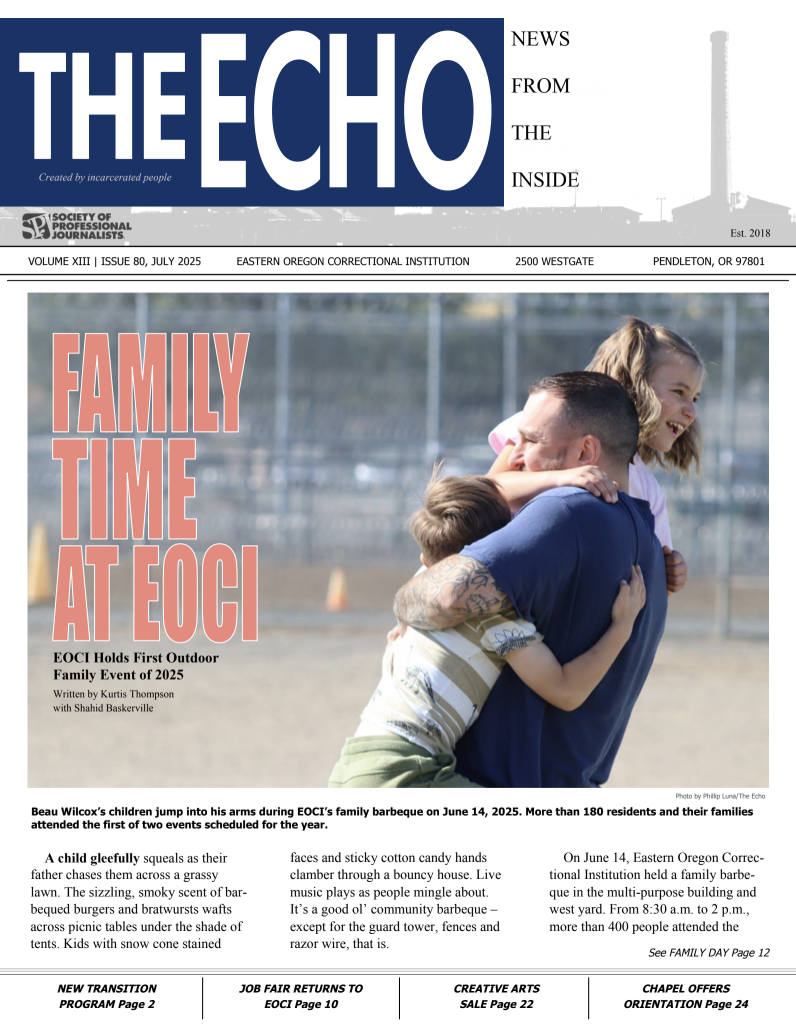
2nd place: "Family Time at Eastern Oregon Correctional Institution" by Phillip Luna, The Echo
The six photographs of the Eastern Oregon Correctional Institution June 2025 Family Barbeque accompanied a cover story… but could have easily been a stand-alone photo series based on their moving testimony to the value of in-person family time. "This is beyond powerful,” one judge wrote, “I was getting goosebumps looking at the photographs."
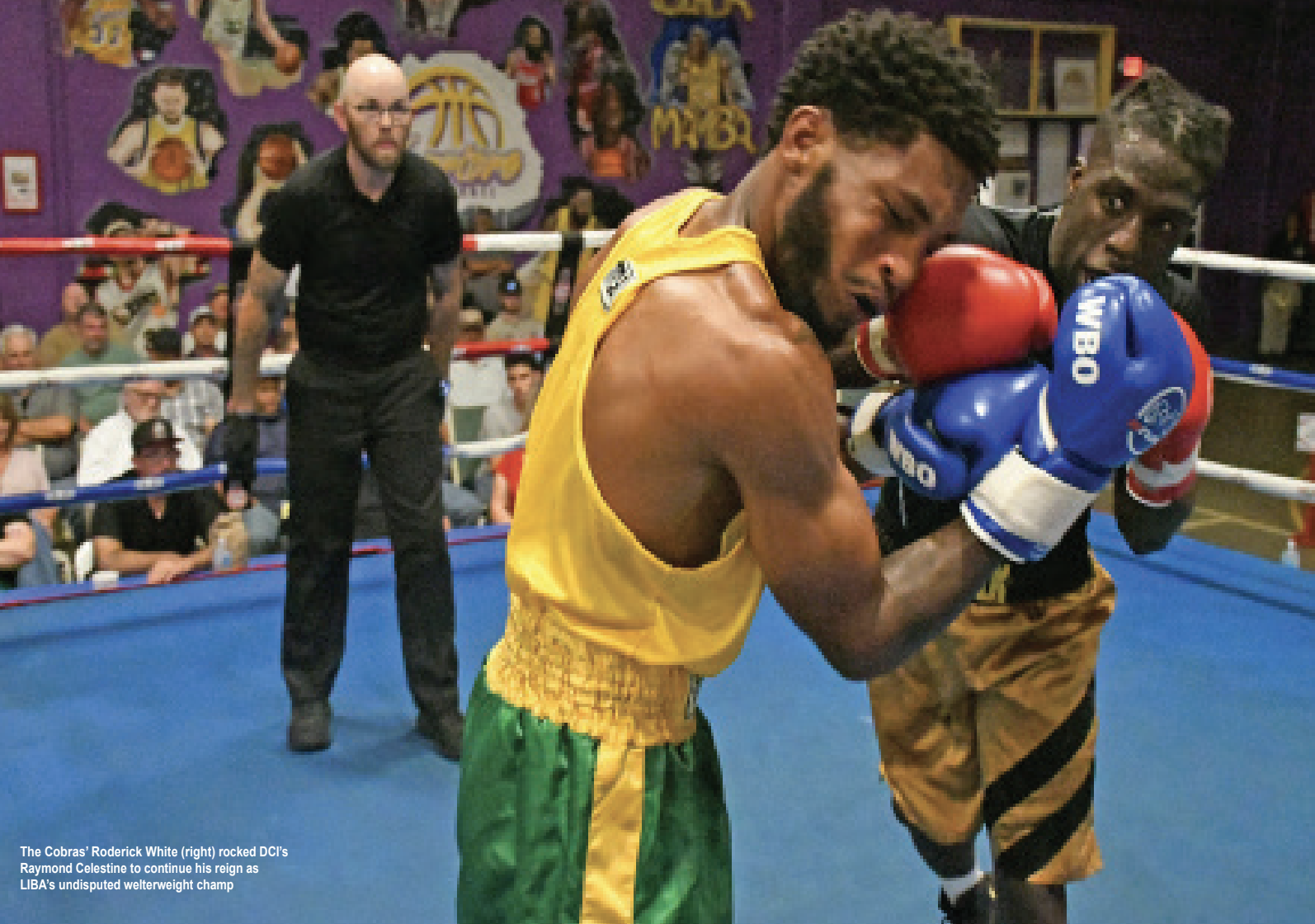
3rd place: "One Battle After Another" Cover Photo by Lawson Strickland
This cover photo from our third place Sports & Recreation Reporting winner, “One Battle After Another,” deserves attention all on its own. Our judge called it “the best single frame in the field and the hardest to get: a welterweight title bout at the instant of impact, both fighters sharp, the referee anchoring the geometry, correctly exposed in a prison gym with no second attempt. The caption names both fighters, both teams and the stakes.” It’s a magical moment.
Advisor of the Year
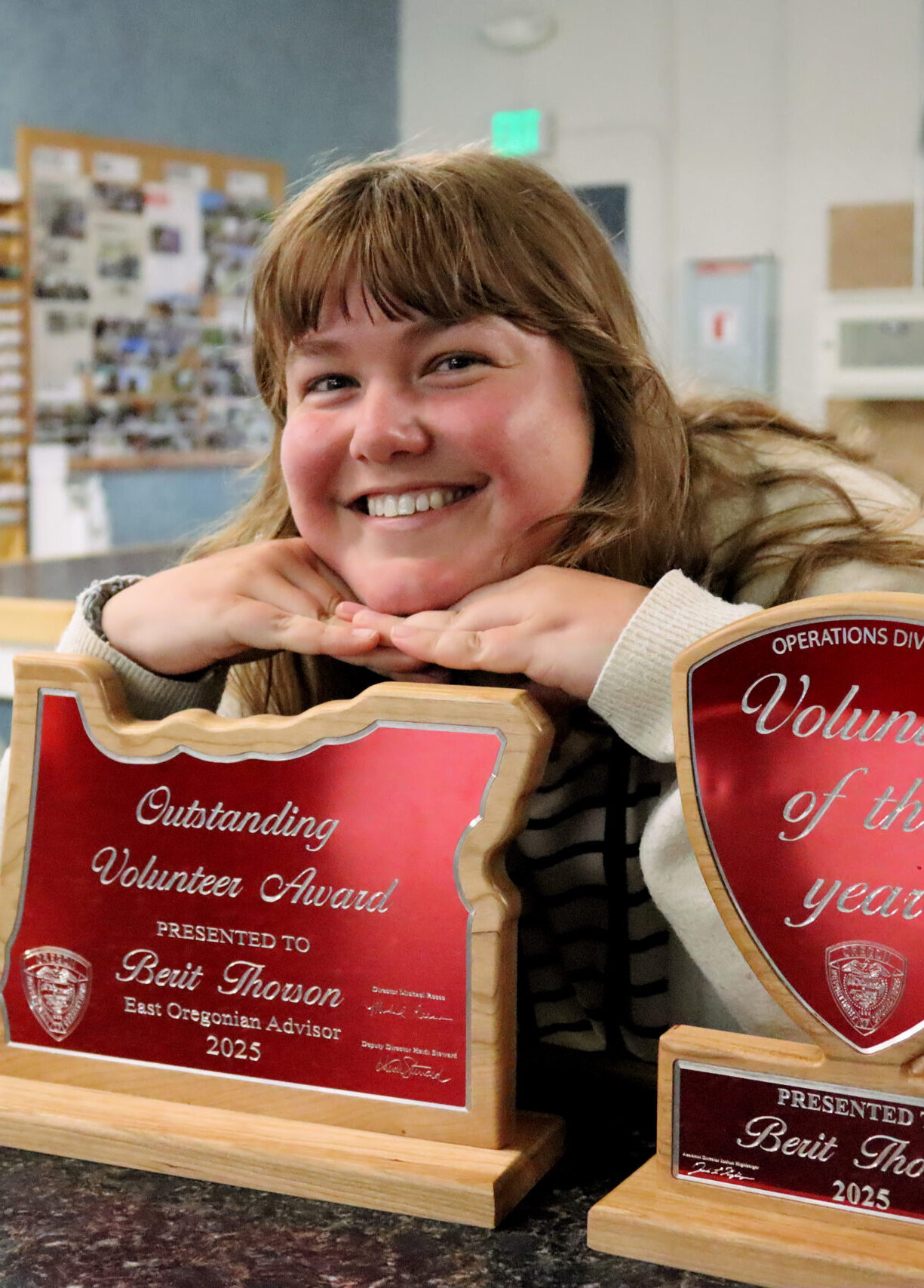
Berit Thorson, The Echo and 1664 Volunteer Advisor
From many strong candidates, Berit Thorson—volunteer advisor to two outstanding publications produced in one newsroom at the Eastern Oregon Correctional Institution—, stood out this year because of how clearly she supports their professional development. Thorson not only provides feedback from her own experience as a journalist, she organizes additional workshops with professional photographers, editors, publishers, as well as with faculty from University of Oregon’s School of Journalism and Communication and one from Blue Mountain Community College. In the words of one judge: “When the writers are calling themselves ‘incarcerated professionals’ and talking about becoming a real journalism department, that says a lot. You can actually see her impact in the journalists they are becoming. That’s what put her at the top for me."
Newsroom Leader of the Year
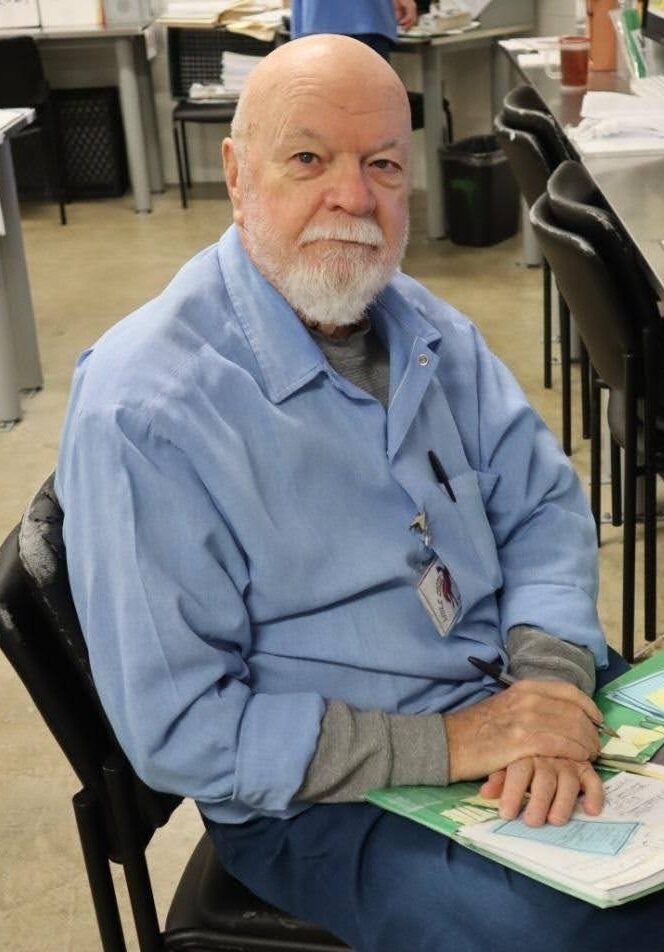
John L. Orr, Mule Creek Post Feature Writer
John L. Orr’s primary title is feature writer. But as we learned from his nomination letter, he also serves as editorial assistant, archivist, supply clerk, researcher and writing mentor at Mule Creek Post. He leads by example with exceptional writing, but is also deeply valued for his calm demeanor, confidence, and the ability to multitask, which make him vital to keeping the newsroom running in the face of deadlines, delays, and a prison bureaucracy. His staff especially highlighted his skill at “providing essential feedback in a caring and thoughtful manner.” For these reasons and more, Orr has earned this year’s newsroom leader of the year.
Woman Prison Journalist of the Year

Nora Igova, CCWF Paper Trail Art and Layout Designer
Despite intense competition from her own newsroom at Central California Women’s Facility and from Mabel Basset Balance, Nora Igova continues her reign into a second year as Woman Prison Journalist of the Year. "Nora’s stuff just stuck with me,” one judge commented. Of the samples provided, the piece that particularly stood out was "Homelessness in Prison." "She found something happening inside that most people outside would never even know existed” according to one judge, “and the story actually got people inside talking about their own behavior. Her work was what I kept thinking about after I finished reading everything."