Graduates of the West Yard CCR program take a different approach
This article was originally published in The Angolite out of Louisiana State Penitentiary. It won third place for Best Short-Form Reporting in the 2026 American Penal Press Contest.
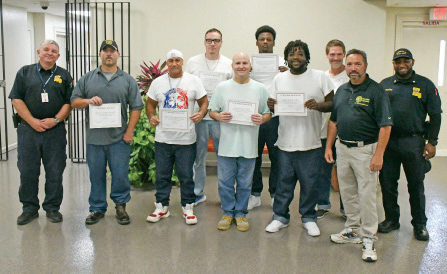
Visitors entering the penitentiary’s front gate often notice a sign along the side of the road that reads, “Angola, the land of second chances.” For graduates of the West Yard’s Closed Cell Restricted (CCR) dormitory program, that possibility came true in late July. Seven formerly segregated prisoners completed three months of communal living to earn the right to return to the facility’s general population. For some, the opportunity was decades in the making.
CCR has a long history at Angola, dating as far back as the 1950s. A housing designation for inmates deemed incorrigible or requiring protection—those guilty of violent assaults on security officers or other inmates; escape risks; new arrivals unsuitable for the general population; ex-law enforcement officers; prisoners with high-profile cases—the classification served to place individuals in solitary cell confinement, sometimes for years.
Changing attitudes towards the use of long-term cell confinement, coupled with lawsuits filed by people held in such conditions, began a shift in the 2000s away from this type of punitive housing. In December 2015, Angola opened a CCR transition dormitory that moved selected inmates from their cells into an open but restricted and segregated environment. The program, originally housed at Camp-C’s Wolf unit, was eventually moved to its current location on the Main Prison West Yard’s Walnut unit.
To qualify for transfer into the general population, former CCR residents housed in Walnut 3 were required to avoid disciplinary problems for 90 days. West Yard security supervisor Assistant Warden Chad Darbonne acknowledged the second chance. “I always say it’s up to you to earn your chance, and all these fellows earned it. Behaviorally, they did good; they showed promise; they showed the prospect of going down the right road after being in the cells for so many years.” What happens going forward is up to those provided the opportunity, Darbonne said. “There’s nothing given to you here; you have to earn it. I felt they earned it, so I gave it to them. It’s theirs to give back or keep. I feel like they’re going to be successful.”
As part of the ceremony, the graduates were reassigned to general population dormitories on the West Yard. The move permits them to participate in the full range of educational, recreational, and rehabilitation classes offered.
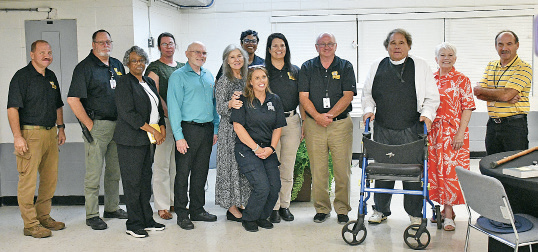
Deputy Warden Rochelle Ambeau congratulated the graduates and offered advice. “I know you want to go home one day, and the Parole Board, they look at our disciplinary actions. The things you do here can determine your freedom. Stay report-free. Do the right thing. I wish you all the best of luck.”
Graduate Trent Miller welcomed the change. An ex-law enforcement officer, Miller was placed in CCR immediately upon his arrival at Angola in 2006. Nearly 20 years later, Miller said he had no expectations of his time going forward. “I would like to be a facilitator or tutor. That’s what I’d like, that’s what I’m into. Right now, I don’t know. The horizon is wide open, and I haven’t even looked around yet. I never thought about it because I never thought I was getting out.”
For others still awaiting, Deputy Warden Kent Gremillion said their time is coming. “We are going to keep doing this. More guys are going to come into the dorm.” Moving forward, Gremillion said the program would no longer be considered CCR but would grow. “It’s going to be considered a Transitional Rehabilitation Unit.” The new unit will offer nonviolent inmates housed in the working cellblocks an opportunity to return to general population. “Guys that maybe have some intoxications, a cellphone, something like that. They’ll do their time, go to work in the morning, and go to school (programming) in the afternoon. We’re going to try something new, and I think it’s going to be a win- win situation.”
Addressing the graduates, Gremillion stressed that help was available. “I want y’all to understand your opportunity and do the right things. You have a lot of people out there. If you need help, if you’re feeling down, go to them. We just want you to do the right thing and help others.”