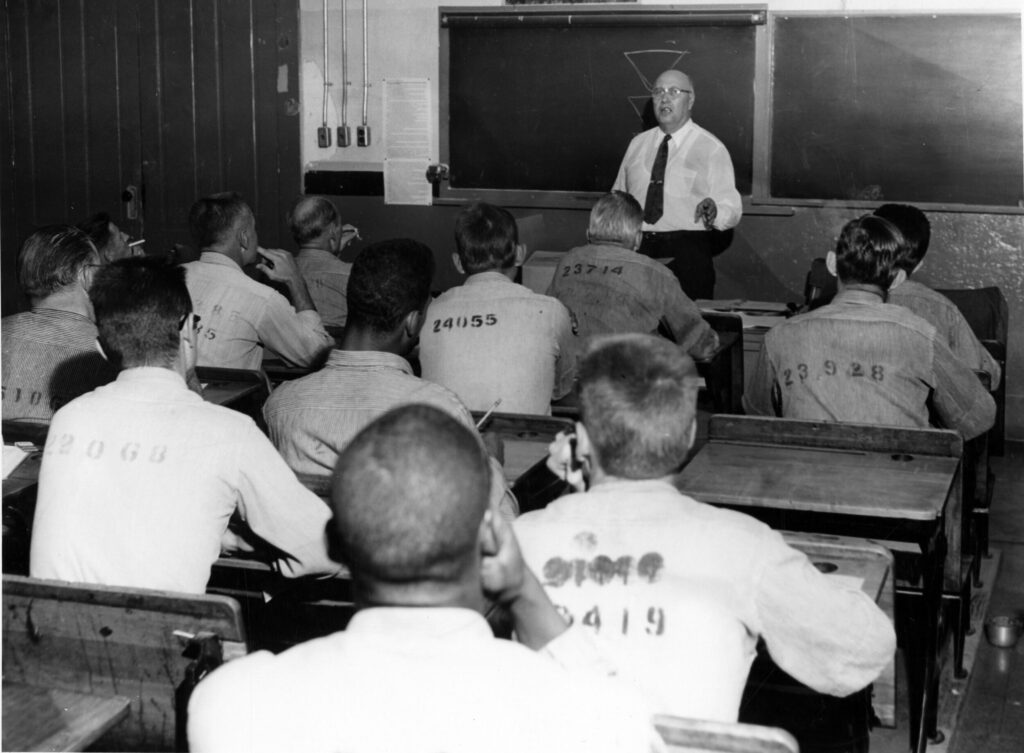
Chances are, if you’ve heard of the American Penal Press Contest (APPC) before this year, it was thanks to James McGrath Morris’ history “Jailhouse Journalism: The Fourth Estate Behind Bars.” The contest makes a brief appearance in a chapter describing the prison press renaissance of the 1960s, where Morris memorably describes it as “a sort of Pulitzer Prize” behind the walls. The book also offers a partial list of award winners in its appendix.
“Jailhouse Journalism” held pride of place on the bookshelves in the San Quentin News ofce, where the two of us started working together in 2018 — Jesse as the paper’s editor-in-chief, Kate as a volunteer adviser. But to hear Jesse tell it, in the monthly rush to complete each issue, the newsroom staff rarely dwelled on its roots. Some had read the book, but no one had fully taken in the breadth of prison media, historically or geographically. At that time, San Quentin News was only in regular contact with two other prison newsrooms, both in California.
San Quentin News does date back to 1940, and had won several APPC awards over the years. But the paper had been out of commission from 1982 to 2008. No one in our orbit had firsthand experience — or even inherited memory — reaching back as far as the contest, which handed out its last award in 1990.
The situation was a little different for Kate, who moonlights as a press historian and who lived for a time within driving distance of the original host institution, Southern Illinois University, Carbondale. After reading Morris’ book, she went digging around in the university archives to see what more there was to learn about the awards. The archives con-
tained some great photos and documents. The last awards supervisor, SIU journalism professor emeritus Walter Jaehnig, sat for an interview and patiently explained why his department had to close the program. The journal Journalism History published a short piece on the APPC by Kate in 2022.
The awards took on a new meaning for us once Pollen Initiative grew out of the San Quentin media center a year later. Our non-profit’s mandate is to create and support prison media centers in California and beyond. The scope of our work got us thinking about the enormous value a contest like the APPC could offer the prison press — the ability to create a national prison journalism community, to pool resources, to give scalable feedback, to encourage healthy competition, and to amplify the prison publications that don’t have the exposure of a San Quentin News. Our goal with this revitalized contest is to do all of these things. We want to see the prison media landscape grow, informed by its own rich history. We approached SIU’s current journalism department with the idea of collaborating on a reboot, and were thrilled when they agreed.
Bringing the contest back required historical sensitivity as well as a willingness to be bold and adjust when needed. We were lucky to have both qualities in our contest project coordinator, Anne Ray, who previously worked as a managing editor at Reveal Digital, where she oversaw the creation of the American Prison Newspaper Archive. Pollen Initiative’s communications coordinator, Veronica Roseborough, helped with so much of the heavy lifting. We were guided by an insightful advisory board, made up of currently and formerly incarcerated newspaper staff, newspaper editors, and journalism professors.
We are also fortunate to have supportive partners at the California Department of Corrections’ Office of Public and Employee Communication and the local San Quentin Rehabilitation Center Administration. Public Information Officer Lt. Guim’Mara Berry goes the extra mile to ensure that the media programs at San Quentin have resources, volunteers, and amplification opportunities—like the American Penal Press Contest ceremony, held this year at the San Quentin Rehabilitation Center.
And none of this would have been possible without a supportive pool of judges, whose expertise ranges all across the journalism landscape. This special issue commemorates the achievements of this year, both by this team and by all of you who heard our call and submitted your best work. We hope these pages inspire you as you think about your newsroom’s goals for 2026. We hope to see you in next year’s contest!
In appreciation, Kate McQueen, Editorial Director & Jesse Vasquez, Executive Director Pollen Initiative