This article was originally published in The Mabel Bassett Balance out of Mabel Bassett Correctional Center. It won first place for Best Short-Form Reporting in the 2026 American Penal Press Contest.
Krysta Muniz talks to her mom at least twice a day, a consistent routine for over five years. Coming to prison before the age of 22, she had to grow into an adult, not through lunch dates and shopping sprees with mom, but through phone calls.
Phone calls serve as a lifeline for those in ODOC custody, but in some states they come at a hefty price. Earlier this year, phone call costs for those incarcerated in Oklahoma prisons fell from 14 cents to 6 cents, only to return to the original rate a few months later. The spike in prices impacts friends and families of those incarcerated, who are now forced to again bear higher prices.
“I have to hear her voice at night,” said Krysta’s mom, Kim Muniz, a waitress with a teenager still at home. “I need to know she’s okay,” Krysta says her mom will call the prison if she has not heard from her. Averaging two phone calls a day via Securus, the communications provider to Oklahoma prisons, to stay connected, Kim spends almost $300 a month.
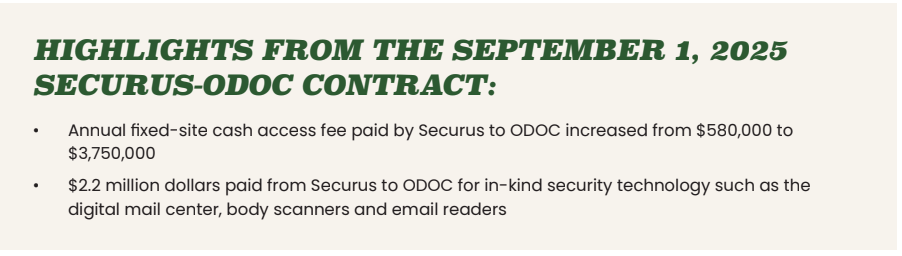
The Martha Wright-Reed Act, signed into law by President Biden in 2023, directed the Federal Communications Commission to issue “just and reasonable” regulations for incarcerated people’s communication services. In compliance with the legislation, the FCC lowered rate caps on phone and video calls and prohibited cash and in-kind commissions, such as services, staff or equipment, from the providers to prisons.
However, on Jun. 30, 2025, the FCC rescinded the rate reduction until Apr. 1, 2027.
Now, friends and loved ones of the incarcerated in Oklahoma are again paying the maximum amount allowed by the federal government.
The high price of phone calls is not inevitable. According to Oklahoma Watch, neighboring states such as Texas, Missouri and Arkansas have held phone calls at five cents to 6 cents per minute instead of mandating the rate cap of 14 cents.
While Krysta and Kim sacrifice financially to stay connected, not all residents have the means to maintain daily contact. Many families live paycheck to paycheck and struggle with any additional financial expense.
Research has confirmed that connections with loved ones make a vital difference to those in prison. According to a 2018 R Street Institute article, the actual proven benefits are better behavior while incarcerated and reduced recidivism once released. These connections also improve mental health, preserve support systems and offer a sense of hope to residents and their families.
“They remind me of the light at the end of the tunnel,” Krysta said. “And remind me of who I was before I came to prison.”
The families share the prison experience with their incarcerated loved one, both the emotional and financial hardships. While Krysta is the one serving a sentence, Kim often tells her daughter, “We have four more years.”
Editor’s Note: Since the writing of this article, the FCC voted on Oct. 28, 2025 to cap prison phone calls at 11 cents per minute opposed to the six cents previously agreed to, with an approved inflation rate of 6.7% included in the ruling, phone call rates will likely reach 12 cents a minute. The FCC decided to reinstate the ban on commissions and in-kind payments to the Departments of Correction. Source: Oklahoma Watch