This article was originally published in The Mabel Bassett Balance out of Mabel Bassett Correctional Institution. It won first place for Best Long-Form Reporting in the 2026 American Penal Press Contest.
In March 2025, panic hit the college department at Mabel Bassett Correctional Center when Rose State College (RSC) emailed the coordinator that they would no longer be participating in the Second Chance Pell (SCP) grant program for incarcerated students. The news spread like wildfire, reducing many students to tears.
Ashley Brown, an RSC freshman, said, “I was devastated because I don’t have family to help me pay for college. For someone like me, I was a high school dropout; seeing the grades I made was motivational. To lose all of that.”
The initial disclosure from RSC stated that the program would end after summer 2025. However, they were able to extend the current Pell grants for previously approved students through the spring 2026 semester. After that, the federal Prison Education Program (PEP) that allows the use of the Pell Grant will not be accessible to their incarcerated students. RSC will continue to offer classes at their nine prison sites with verification of ability to pay. The college currently serves approximately 165 students using the Pell Grant. The number of students will drop significantly when federal funding becomes unavailable.
RSC initiated the SCP program for those with five years or less at MBCC in spring 2021. They increased enrollment to include all sentences except life without parole in spring 2024. MBCC currently has 65 RSC students and had planned to enroll substantially more in fall 2025. They had more than 100 approved FAFSA applications. The announcement was a shock to both RSC professors and DOC college coordinators.
Rachele Lowry, the MBCC college coordinator and Oklahoma Department of Corrections 2025 Teacher of the Year, reflected on her dismay when she received the email: “So many of my students have unrealized potential. Watching them flourish in the college program and begin to believe in their own abilities… I am heartsick about the loss of the Pell and the new students it could have helped.”
The RSC student handbook states that “Rose State College provides higher education programs and services intended to foster life-long learning for a diverse population.” RSC core values tout the importance of different backgrounds and perspectives. The college’s commitment to community has been reflected in their services to the prisons, but even this commitment is challenged by economic hardship. RSC expressed regret, saying that financial costs to administer the program were the primary cause of their decision to exit the program.
Many, however, might question why it is important for higher education to be available in prisons.
Economics is the first answer. According to a 2016 U.S. Department of Education Study, from 1979 to 2013 state and local spending increases outpaced the funding of pre-K-12 public education three to one. In 2021, the Justice Center issued a report projecting Oklahoma would spend $129 million in 2022 just for costs of those returning to prison.
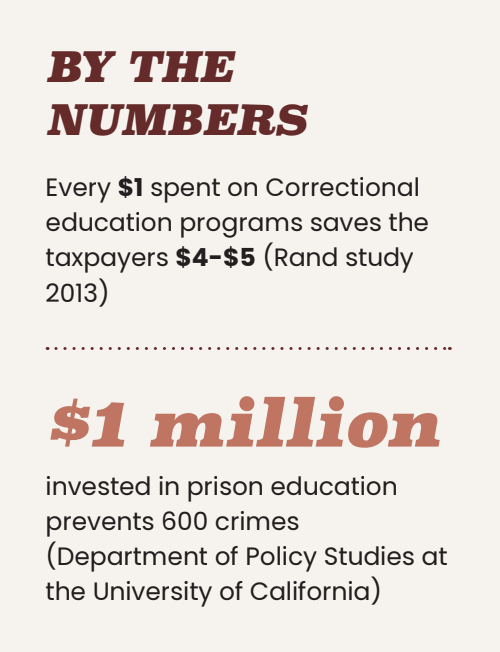
Any decrease in recidivism will result in real dollars that can be better used in our flagging public education system or other infrastructure programs. A 2013 RAND study showed that for every dollar spent on correctional education programs, including college, taxpayers save $5 from future crime and incarceration rates. Additionally, a Department of Policy study at the University of California found that every $1 million invested in education can prevent 600 crimes.
A 2019 Vera Institute article reported that Tulsa Community College awarded 500 associate degrees since 2007 to incarcerated students. The recidivism rate for these graduates was only 5%, compared to a normal recidivism rate of nearly 70%. In general, incarcerated students involved in post-secondary education are 48% less likely to recidivate than those who are not. As the level of the degree increases, the rate of recidivism decreases even more.
According to a 2022 Bankrate article, by 2027, 70% of jobs will require some sort of post-secondary degree or training, but only 6% of the incarcerated individuals nationwide have access to these forms of education. Those with felony records earn an average of 41% less than those without a record of a similar age.
Broader access to college will better prepare incarcerated individuals to earn a living wage when they are released. The ability to adequately support themselves not only ensures formerly incarcerated persons rely less on public support but that they will contribute their share of taxpayer dollars, effectively improving the community for everyone.
In addition to the societal economic benefits and reduced recidivism, significant personal benefits can be associated with prison college programs, including greater political engagement, more volunteerism, and improved health after release.
Generational benefits are also a factor since more than half of those who are incarcerated have minor children. Just as children with an incarcerated parent are more likely to be justice-involved, children with a parent who has a college degree are more likely to take education seriously. Changed mindsets can interrupt cycles of incarceration and end generational poverty for many families.
Not only does college improve lives post-release, but it also has an impact within prison. Prison residents that participate in post-secondary education commit 75% fewer infractions since these programs are contingent on good behavior. A college education produces mature, well-spoken leaders who can have a calming effect in high-stress environments such as prison.
Many college students realize unrecognized potential through college participation. Layna Fischer, an RSC sophomore, carries a full-time college schedule while maintaining a 4.0 grade point average. She now has much larger aspirations, wanting to pursue a long-held dream of becoming an anthropologist. “A college degree never seemed possible before the grant,” she said, “since I had my children and bills.”
Choosing not to participate in the Pell grant program is a growing trend across the nation due to increased costs imbued by colleges as well as added scrutiny and staffing issues. Several suggestions have been proposed to increase the economic impact and bolster public opinion of prison higher ed programs:
- Allow Department of Corrections officers and other staff members to take college courses in the prison college program to increase career opportunities. Not only do employees have access to financial aid if they qualify but DOC provides additional benefits to employees who earn a post-secondary education degree.
- Encourage state community colleges and universities to participate in PEP. These colleges could add fees approved by State Regents to help offset the cost of additional staff members, accreditation and regulatory requirements, secure-network internet-based access and any other unforeseen expenses.
- Publicize college PEP results, recidivism rates and inmate behavior patterns to allow the public to see tangible, positive outcomes. For example, in spring 2025 MBCC had 78 college students with a cumulative GPA of 3.52.
- Build a system of state-funded and volunteer donor support for higher education and the PEP program. The Pell Grant was intended to supplement other payment methods for secondary education, not supplant them. Additional financial support and political support is sorely needed to foster higher education.
Those who leave prison directly affect Oklahoma communities, since over 95% of the incarcerated population will someday be released. Education is one of the most transformative tools available. Funding college and other post-secondary programs is the best way to decrease recidivism and increase public safety while allowing the formerly incarcerated the chance to contribute to the prosperity and well-being of our state and local communities.