A limited Cobras roster attempts to hold the line in a long points chase
This article was originally published in The Angolite out of Louisiana State Penitentiary. It won second place for Best Sports & Recreation Reporting in the 2026 American Penal Press Contest.
The Louisiana Institutional Boxing Association (LIBA) took its show up North—deep into the pines of Claiborne Parish— for its first Fight Night hosted by the David Wade Correctional Center (DWCC) in Homer. Boxing teams from Dixon Correctional Institute (DCI), Elayn Hunt Correctional Center (EHCC), Louisiana State Penitentiary (LSP), Rayburn Correctional Center (RCC), and Raymond Laborde Correctional Center (RLCC) made the long drive to converge near the Arkansas border for LIBA’s seventh meeting of the year.
A small satellite prison loathed by most prisoners for its isolation, reputation for militantly restrictive policies, and notorious N5 cellblock unit designated for high profile prisoners—convicted judges, police officers, political figures, and those deemed as high security or disciplinary risks— Wade joined LIBA in 2024. It has since become a driving force in the boxing association, fielding a growing stable of fighters claiming title fight points in pursuit of LIBA’s championship banner.
“We added this new team and for the last year or two, they’ve been traveling everywhere and hadn’t had a chance to host one. So, we all had a pretty good ride to get here,” LIBA Commissioner Todd Singletary said. “Having a new team brings some new opponents and faces in all the different weight classes. This is really exciting for me.”
In 2024, three Wade fighters—featherweight Russell Lopez, junior welterweight Dwight Berry, and light heavyweight Lester Ramsey—competed in seven title fights, amassing a perfect record of 7-0 for the Warriors. This year, the Warriors sit second to the LSP Cobras in the championship banner chase with an expanded roster of eight fighters amassing 19 points from 28 title bouts.
For LSP, the season has been an uphill push to maintain control of the banner chase with the Cobras limited to three consistent fighters: welterweight Roderick White, middleweight Garard Achelles, and heavyweight Trevon Wiley. Inconsistent support has come from super heavyweight Harold Julien, along with a cast of other hopefuls who have passed through the Cobras’ training ring before disappearing—featherweight Robert Brown, junior middleweight Shama Davis, middleweight Ross Kelly, and light heavyweight Sean Newton.
In the world of institutional boxing, where individual glory is secondary to the pursuit of team championships, a key factor is strategy. This year, White has been called on by necessity to move between welterweight and junior middleweight; Achelles from middleweight to light heavyweight and back again; with Wiley—long a dominant figure in the light heavyweight division—roaming the top weight classes as high as super heavyweight, as part of Cobras coach Anthony Harvey’s schemes to block opposing teams from securing easy wins.
Arriving at Wade after a five-hour trip—to then be processed through various strip searches, full x-ray body scans, and a shakedown of the team’s equipment, food, and water— White and Wiley weighed in, in defense of their respective welterweight and heavyweight titles, with middleweight champ Achelles moving up to light heavyweight. Also on the card for the Cobras was Ross Kelly, weighing in to face EHCC’s Gregory Vincent for the junior middleweight title.
True to Wade’s reputation, stringent rules were enforced, denying visiting boxing teams from entering the facility with their food, Gatorade, water, and other consumables—as well as any paper, pens, cameras, or recording devices used by team bookkeepers, statisticians, or journalists attending the event. The policy posed a particularly severe blow to the boxers, many of whom fast hours before weighing in, and expend tremendous amounts of energy over three rounds of physical combat inside the ring.
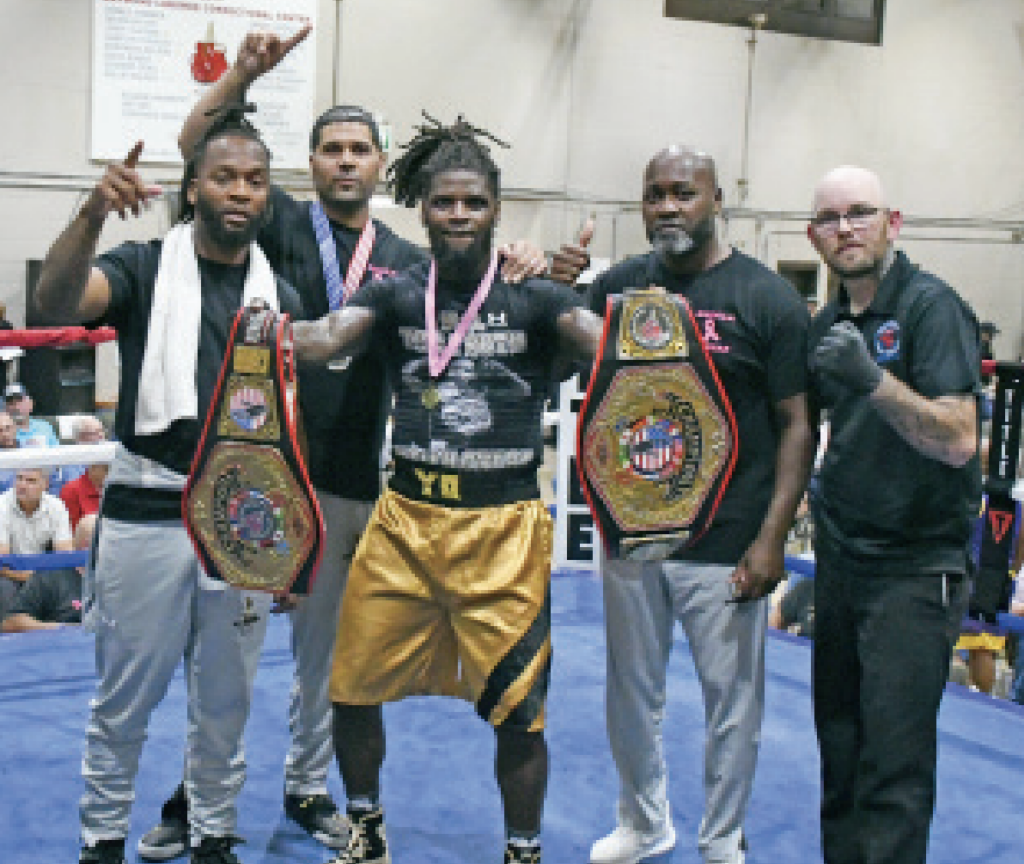
Whether these measures were implemented with malicious intent—for a tactical advantage for the home team—or simply out of an ignorant disregard for the health of athletes, the night proved to be a wash between the Warriors and Cobras. With a full fight card of nine title fights, eight of which featured either a DWCC or LSP fighter, both teams walked away with three championship points.
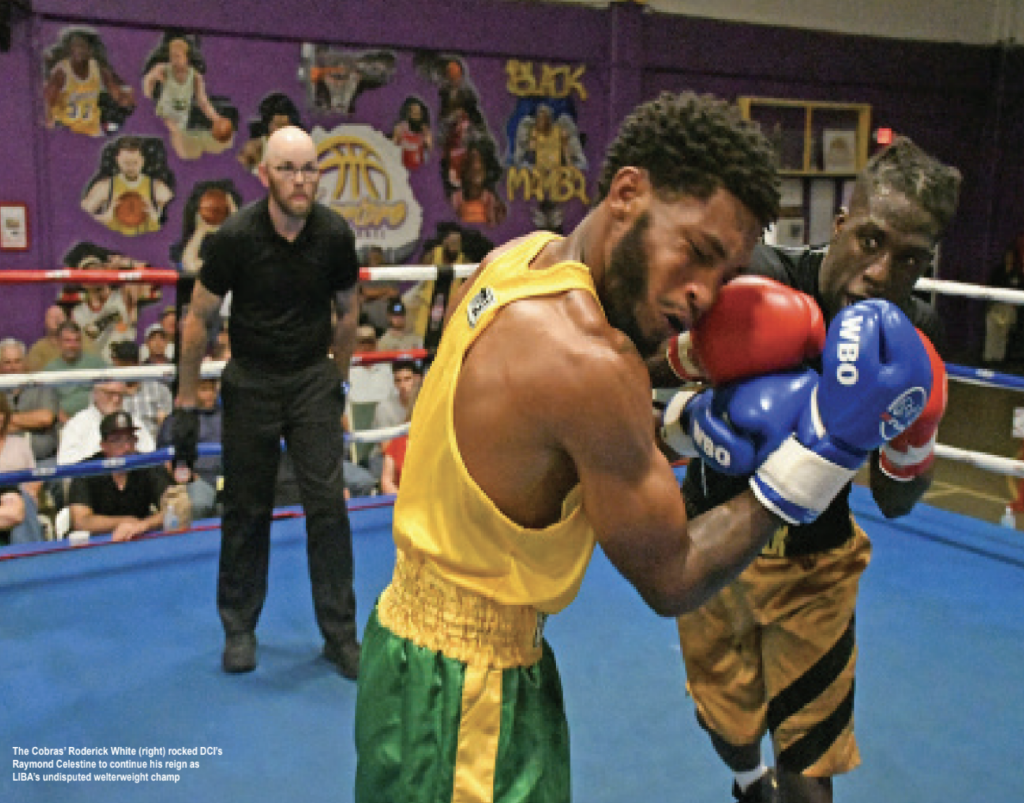
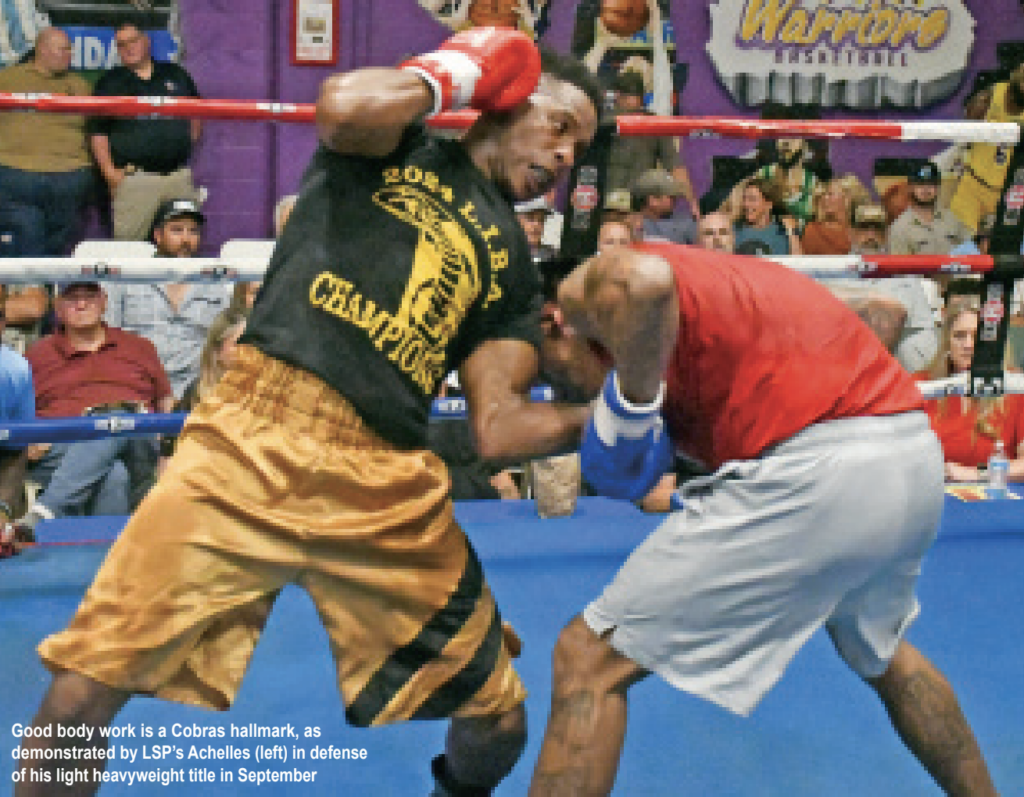
Welterweight champ White worked the jab while landing power shots to defeat DCI’s Raymond Celestine by unanimous decision. Fighting as a light heavyweight for the second time this year, Achelles defeated RLCC’s Arturio Rodriguez. Going to the body with vicious hooks to the ribs and kidneys, Achelles dropped Rodriguez to a knee for a standing 8-count in the first round. Concerns from the Cobras corner rose midway through the second, with Achelles suffering an apparent right hand injury, but the experienced fighter worked through the remainder of the bout with control, utilizing the left, jabs, and ring movement to secure a unanimous decision.
Defending his heavyweight title, Wiley defeated DCI’s Terrance Hudson in a bout decided more by what didn’t happen than what did. A tall, lanky fighter with a sizable reach advantage, Hudson sought to evade Wiley’s power throughout the fight. Accused of running throughout all three rounds, Hudson utilized ring movement to repeatedly spin away from attempts to pin him along the ropes, leaving a frustrated Wiley facing empty air through much of the fight.
A lack of offense on Hudson’s part and Wiley’s pursuit as the aggressor—combined with brief scoring opportunities—were the determining factors in awarding the fight to Wiley by unanimous decision.
The Cobras only failure was junior middleweight Kelly’s loss to EHCC’s Gregory Vincent. With an opportunity to extend the team’s points lead, Kelly put on a tentative performance. Faced with an aggressive inside brawler willing to exchange punches, the 37-year-old Kelly spent the majority of the bout in a defensive posture, backing away from pressure and attempting to counterpunch, which was not enough. Vincent retained his junior middleweight title by unanimous decision.
LIBA reconvened in early October at RLCC for eight title fights and two #1 Contender bouts. The event coincided with Breast Cancer Awareness Month with all proceeds from inmate food concession sales donated to breast cancer research. Contributing to the cause, DWCC donated $3,000, with RLCC adding and additional $3,500, to support the Breast Cancer Crusaders advocacy group.
Coming into October, LSP led DWCC 21-15 in points. Tying on the gloves for the Cobras, Achelles, Wiley, and White represented a limited roster versus six fighters weighing in for the Warriors. A matter of statistical fight opportunities— with only two Fight Nights on the remaining LIBA calendar—each trip to the ring represented a critical moment for both club’s championship hopes.
Fighting first for the Cobras, White squared off with DWCC’s Steven Tate. An aggressive fighter who last fought as a novice in a junior middleweight bout, losing to LSP prospect Shama Davis in June, Tate opened the first round aggressively, attempting to press and bully White. Both fighters set a frenetic pace, with White pulled into Tate’s fight instead of prosecuting his own. But conditioning always falls in favor of the Cobras.
Unable to sustain the pace, Tate began to fade in the second round, succumbing to White’s continued fight tempo and pressure. Between the second and third rounds, the DWCC fighter sat in his corner, visibly exhausted and mouth-breathing, unable to take water.
With complete control of the bout, White beat a spent Tate through the third round, lacking only the power to finish the fight by knockout, to win by unanimous decision on the score cards.
Returning as a light heavyweight for the second Fight Night in a row, Achelles faced DWCC’s Quantavious Green. Achelles met Green—a legitimate light heavyweight with moderate power—last June, pulling out a split decision win. In that effort, Achelles outworked Green, utilizing ring movement and punch accuracy to stay on top fight. He failed to replicate that performance a second time.
A disastrous fight for the Cobras, Achelles started slow, allowing Green to establish the style and tempo as the fight progressed. With seconds left in the first, Green dropped Achelles following an exchange of punches along the ropes. Ruled a knockdown by the referee, Achelles was given a standing 8-count as the bell rang.
Continuing through the second and third rounds, Green backed and counterpunched, landing numerous power shots in flurries, leaving Achelles to stalk and stalk and stalk until he stalked himself out of the fight, ending the third round without ever effectively letting his hands go. A poor performance, with Achelles appearing unwilling endure Green’s power, the loss ceded a much-needed championship point to DWCC.
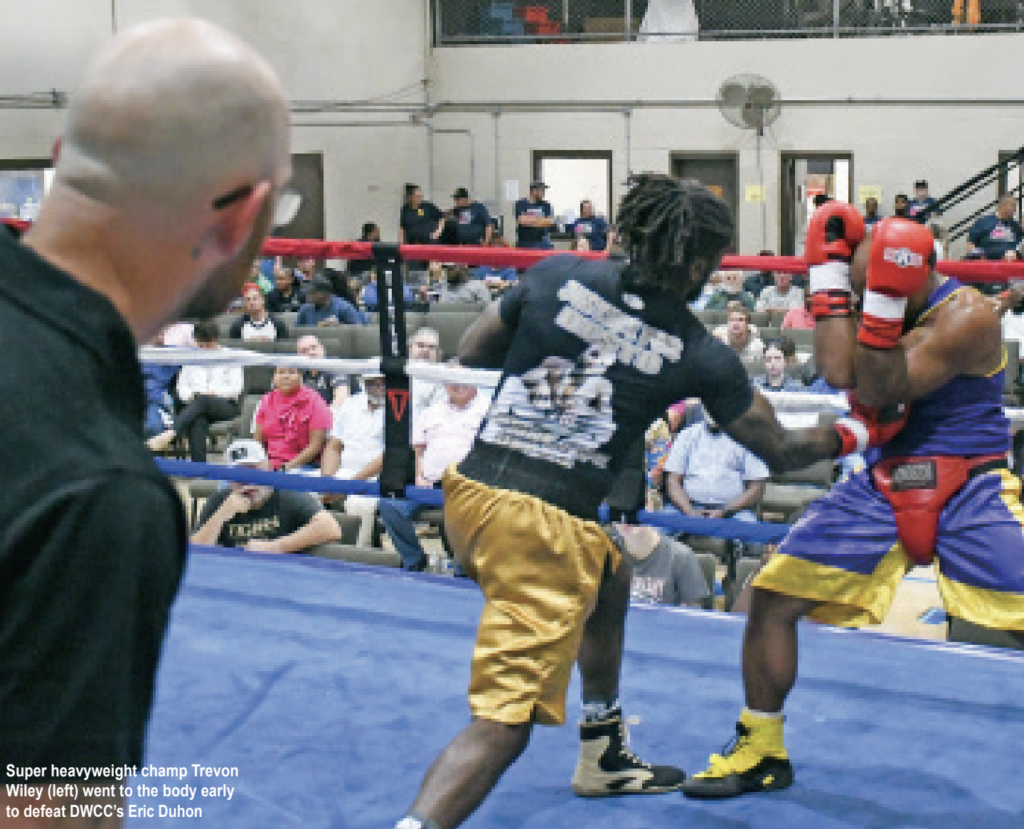
Last to the ring, Wiley—moving up from heavyweight—met DWCC’s Eric Duhon for the super heavyweight title. A mismatch from the opening bell, Wiley dominated a lackluster bout to win by unanimous decision. Faced with an apparent lack of competition, Wiley coasted, fighting in spurts and flurries, with Duhon surviving to the final bell due to a seeming lack of desire by Wiley to finish the fight. The only positive takeaway was Wiley’s excellent body work, delivering his most effective shots to Duhon’s midsection, eschewing a knockout shot to the head that should have ended the bout early.
Fight results for DWCC on the night earned the Warriors four championship points from six fights, narrowing the Cobras lead to 23-19. Closing in on the end of the season with a shrinking advantage, LSP’s banner hopes will now rely on the number of fighters it can put in the ring and their desire to win in the face of superior numbers. It may well come down to the last fight of the year, one that will be held on the Cobras’ home turf, before a Cobras’ home crowd.