This article was originally published in The Elephant in the Room out of Monroe Correctional Complex. It won first place for Best Opinion in the 2026 American Penal Press Contest.
Prison life isn’t easy. We all look forward to the day we are released and head back into the outside world. Ultimately the goal is to reenter it a better person than when we came to prison. Unfortunately, for most of us there are some things that do not allow us to reenter in better condition than when we arrived. A study found that for each year spent in prison “translated to a 2-year decline in life expectancy”. It’s easy to see how. One of the things that can negatively impact Incarcerated Individuals (I/l’s) in more ways than one is our food here at Sky River Treatment Center (STRC). It only takes four weeks of eating a poor diet to cause a lasting impact.
Current Impact
The current environment in the Washington State prison system is that our food service and commissary services are controlled by Correctional Industries (CI), the revenue-generating arm of the Department of Corrections (DOC). We are served three meals per day, two “hot” meals and one “cold” meal. Individuals with special meal needs such as diabetic, kosher, vegetarian, and halal are made available upon approval from a medical provider or chaplain. The only information we are given about our meals is that they supply at least 2000 calories per day. Bare minimums of nutrition are met, but not in compliance with the WA Department of Health-Healthy Nutrition Guidelines as intended.
Our meals are not prepared fresh and on-site at SRTC. Nearly every item comes from a can, box, or bag. CI relies on ultra-processed, pre-made foods because they can be heated and served quickly due to the fact that equipment may be limited to ovens or steam kettles and the staff may not even have basic culinary skills other than knowing how to take the temperature of reheated food. The majority of our meals start out hundreds of miles away in either Airway Heights or at Coyote Ridge Correctional facilities in one of the two “food factories” which are operated by Cl. The remaining supply of our food comes from large national companies such as Sysco, Food Services of America, etc. These companies supply food to restaurants and all types of food service situations. Part of that becomes the “Secondary Food Market” in the United States with estimated revenues of over 2 billion dollars a year in the United States.When food is not quality enough for the “Primary Food Market”, is ready to expire due to its shelf date or is being discontinued, instead of losing money due to spoilage, they sell it to other institutions like prisons who will pay the lower cost for a diminishing product that no one else wanted. This is why we are given kiwis the size of walnuts or golf balls, unripe apples, bags of baby carrots by the truckload pushing expiration date that noo grocery store or restaurant wants.. Just the other day we recerved a bag of ultra-processed Buddig brand sliced beef which had a use by date of January 2025
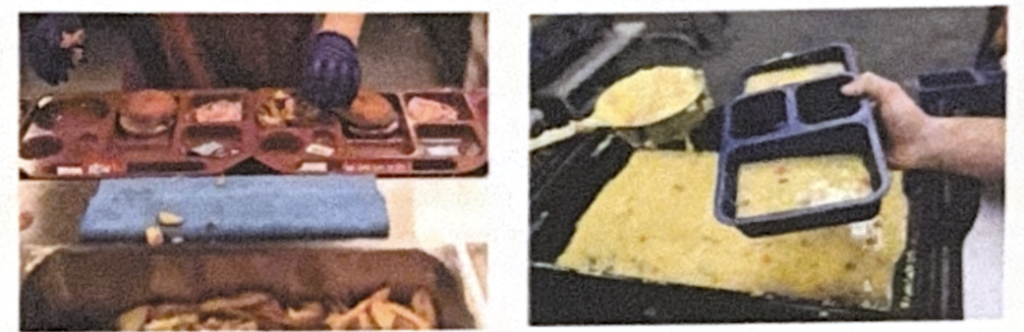
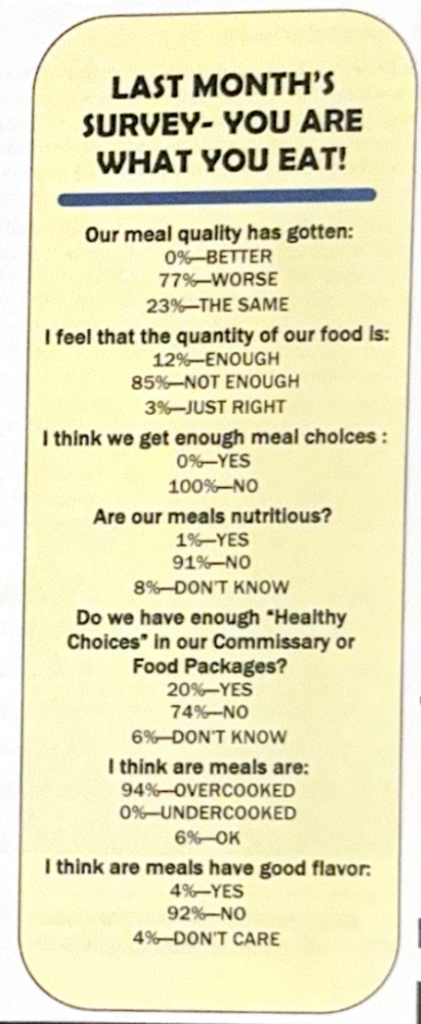
which was five months ago. I’m sure these are frozen at the expiration date and then sold at a discount, further reducing the cost and nutritional value of our meals. Even after the period of COVID, we received TV Dinners prepared at Airway Heights or Coyote Ridge that had preparation dates up to 14 months before they were served. The list of ingredients on these showed plenty of preservatives as well. Currently, our food is “reheated,” which results in it being cooked for a second time, often resulting in food that is dried out and overcooked. Rice and pasta have returned to a hard state; sauces are dried up and hard to the tray; cross-contamination of unwashed fruits such as kiwis, bananas, apples and oranges are sitting in salads of dressings and vinegar, along with bread or dinner rolls. Entrees are blackened and dried out as well. When asked if they have any trays that are not “burnt”, I/I’s are told, “they are all like that”, “we don’t cook it here”, “we can’t control the temperature since everything is automatic” and “if you don’t like it, file a grievance”. This lack of attention to detail and “customer service” falls on the CI management of not accommodating each meals “reheating” needs better and educating the workers on how to monitor it better. It is stated that if you have any issue with your tray, it must be addressed at the window. But if you try to address issues, you can be threatened or can be written up for holding up the line or harassing the workers. This doesn’t allow concerns to be dealt with at the point of “sale”. Meal portions and quality have declined by at least 50% in the past few years and the number of choices has drastically declined as well, resulting in most meals being repeated nearly every other day and empty spaces on our trays.
Impact Before
Prior to 2013 when CI ramped up control of food services at allDOC facilities, food was sourced as locally as possible and meals were made from scratch in prison kitchens. This gave 1/I’s actual hands on experience developing kitchen and food preparation skills that could actually become employable skills upon release. Menus were planned by the Kitchen Manager and varied depending more on local provisions that were available. I/I’s tell of meals in the past and how much better and happier they were.
In 2013 Cl was controlling the food service operations at five facilities and increasing to the rest of them rapidly. In 2015 CI took over at Monroe Correctional Complex (MCC) of which SRTC is a part of. At that time, John Holman was a food manager at MCC. After decades at MCC he took pride in serving locally sourced and produced food, even serving fresh milk from a nearby dairy farm. He was instrumental in teaching I/I’s how to cook properly from start to finish, including thawing, cutting and slicing, cooking, heating, serving and maintaining a kitchen environment. “They were learning more. They were making mistakes,” he said. “But one thing you have to think about is, I’m trying to teach I/I’s how to cook beef stew and they are messing up. But they are still making homemade beef stew. The value in that is tremendous. But to just boil a bag to make sure it’s 160 degrees, there’s no value in that. Everybody can see that.”
He was given an ultimatum by CI, agree to serve their food and their menu, or retire early. He took the latter, saying, “I can’t work under your guys’ organization. So it began, the shift from local ingredients and meals made in-house to a mode of mass production akin to a fast food franchise. Yet the operation and its so-called “savings” have led to dissatisfaction with the food itself.
In 2013 Gov. Jay Inslee signed Executive Order 13-06 requiring that all state food facilities, including kitchens that serve I/I’s meet minımum health standard guidelines that were given by the WA Department of Health—Healthy Nutrition Guidelines, stating, “we are making the healthy choice the easy choice”. In reality, the DOC through a decades-long takeover by CI of food services, commissaries and food package programs, have implemented policies that systematically deny healthy choices to I/I’s. Unlike others affected by state food policies, I/I’s can only eat what DOC makes available. These polices have eliminated the cooking from scratch of locally-sourced food to an industrial model that damages both health and the environment through plastic packaging and transporting highly processed food products across the state.
In 2018 Cl officials said they were receptive to the idea of completely changing the menu to meet I/I’s desires and needs, saying that it’s something that is constantly in flux. Have the I/I’s ever had the opportunity to be surveyed about what those desires and needs might be? I don’t think so. Jamie Dolan a food administrator with CI said, “if necessary they could include a complete overhaul. Whether that means renovating their food processing facilities, Airway Heights included, or tearing down the factory model altogether, only time would tell.” Maybe now is the time to take a fresh look at the process for the better…not just the bottom line.
The Nutritional Impact
In short, the current system prioritizes the lowest cost over the health and dignity of I/I’s. Our meals run about $1.10 per meal or about $3.30 per day. With constraints like these it’s no wonder that correctional facilities fall short of providing a healthy dietary program. The U.S. Food and Drug Administration’s (FDA) “Thrifty Plan” estimates that feeding an adult man “a nutritious, practical, cost-effective diet” costs about $10 a day. For example, we are fed insufficient servings of fruits and vegetables and excessive sodium. Cheap forms of carbohydrates are used to meet calorie requirements and nutrition comes in a daily powdered “juice” package which is sweetened with Aspartame (which has been linked to cancer).
When a registered dietitian is involved in the process, that professional’s approval may function more like a rubber stamp than a genuine endorsement of proper nutrition. Some dietitians working in prisons have said that they wish prison meals included more fresh fruits and vegetables instead of relying on “fortified powdered beverages” to supply “essential nutrients”, and had fewer carbohydrates, which is the least expensive way to reach a required calorie count. The DOC and CI should collaborate with The University of Washington’s Center for Public Health Nutrition (CPHN) to carefully evaluate what is actually being served rather than what CI claims is served.
If you have had a chance to speak with the DOC Nutritionist, as I have, the follow-up included a sheet on how to read a Nutritional Label. Easy enough, but perhaps it would be applicable if we were given accurate, transparent nutritional information of all of the items that are included in our meals. If you ask at a fast food restaurant for nutritional information on their food, they gladly supply you with a complete account of that information on all products. Having this along with healthier choices would allow I/I’s to begin to understand more about what they are consuming and perhaps make changes in their diets for the better.
Medical/Dental/Vision Impact
Many people are surprised to learn that healthcare costs take a much larger portion of the overall cost of incarcerating a person than food does. In 2011, healthcare represented an average daily cost of about 19% of the total bill, while only about 4-5% is allotted to food. A healthy diet is linked to a lower nsk of diabetes, heart disease, some cancers and other chronic diseases, but a poor diet can lead to a lower quality of life, premature deaths and higher healthcare, dental, vision and mental health costs over time. People in prisons were found to be 150% more likely than the general population to report histories of diabetes, asthma, or high blood pressure, according to the U.S. Department of Justice. Nearly 1 in 4 have hypertension. They too, have higher rates of heating, vision, cognitive and ambulatory disabilities than the general public, which poor nutrition in prison surely doesn’t help. DOC’s 2012 Annual Report stated that diabetes and hypertension are among the top five chronic care areas for 1/I’s. According to the American Diabetes Association, an estimated additional $25,675 is spent annually on diabetes related health care per I/I inflicted. “While less costly initially, hypertension leads to more expensive issues if heart disease results, as it often does. Poor nutrition is a primary contributing cause for both of these preventable diseases. The costs of treating these diseases dwarfs the cost of preventive care of providing a healthier diets to incarcerated people. So the quality of food served to I/I’s has a profound impact on the long-term health of a large part of the incarcerated population, especially those with long sentences.
Prisons provide a perfect opportunity for implementing public health nutrition interventions because of the controlled food environment. Studies show that many I/Ps gain excess weight while incarcerated due to the cheap carbs as well as medications they are one which could also be due to diet. Prison food also has health implication for health equity. Black, Latino and Native Americans are also burdened with higher rates of chronic diseases that can be influenced by diet.
Mental Health Impact
In 2020, Impact Justice published the first national investigation of the food environment in prisons, finding that, in general, the experience of eating in confinement is profoundly dehumanizıng. They also found no shortage of opportunities to improve food and nutrition in adult and youth correctional facilities. Poor meals do have an effect on an I/I’s mental health. I/I’s need proper nutrition that helps with the medications they are taking and can also help to manage weight issues that sometimes accompany certain medications. When they feel they are getting the same old food or not enough food they can become very agitated which can not only put staff but other I/I’s in danger if they become violent due to a combination of these factors. Complaints about food are frequently cited during prison strikes and riots, events that are very costly from a security standpoint. This happened in Walla Walla in 2018 resulting in the removal of cold “breakfast boats” and implementing hot breakfasts 5 days a week, although it took another 3 years to offer it at SRTC.
The Commissary Impact
The poor quality of our meals means that I/I’s with sufficient means rely on the commissary for a lot of their meals or to supplement or enhance them, which is hardly the best solution. Our commissary is known for its lack of healthy options, mostly offering expensive, shelf-stable snacks and beverages high in saturated fat, added sugar and salt. It’s a perverse incentive that the worse the meals the greater need to spend. Crappy food is being paid for twice, and the state ends up paying for the medical care because of it. In 2017 the Washington State Department of Health (DOH) facilitated a work group to plan, implement and evaluate the Healthy Commissary Project (HCP), with the goal of improving the nutritional quality of items offered in state prison commissaries. This group consisted of the DOC, the DOH, and the Statewide Family Council (SFC). Our commissary forms have a “Best Choice” indicator which tell us which items are “better” but cannot always be called “healthy”. CI developed three categories for commissary items, “Best Choice”, “Better Choice” and Limited”. Limited products contained high amounts of fats, sugars, or salt, but they do not meet “Better Choice” guidelines. Better Choice items were lower inin fats, sugars and salt than Lamited items. Most of the “Best Choice” items are coffces/teas, some cereals and nuts, but not much else. “Better Choice” was included as a category because CI’s old procedure had three categories and CI wanted an intermediate category to show that they were offering some products that met at least some nutrient guidelines. The following are the percentages of “Best Choice” options in each category in the commissary:
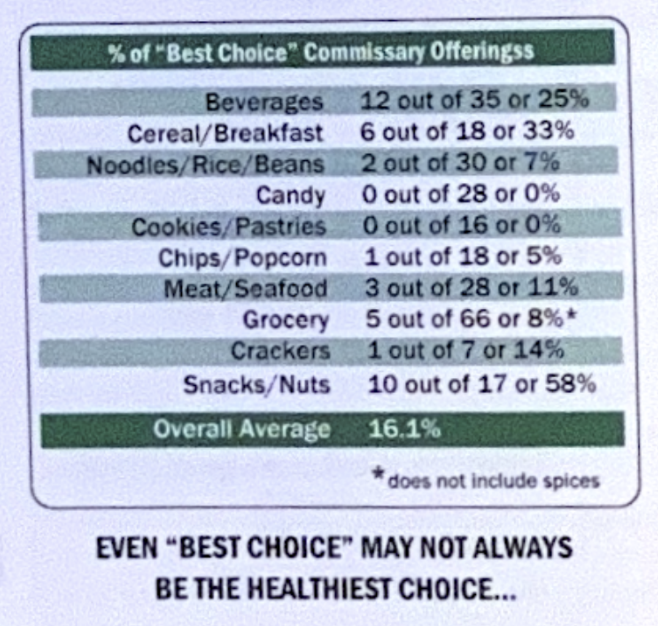
An average of 16.1% overall which leaves 83.9% of choices are open for interpretation of their nutritional value due to the high level of processing and preservatives they offer. After a two-year study on Best Choice” sales, the data showed no real change in purchases. CI claimed to offer to promote healthier commissary products through posters and newsletters, none of which I have ever seen or heard of.
Environmental Impact
The constant use of prepackaged food in plastic wrappers, spoons and packaging not only costs to produce, but the impact to the environment is notable. The amount of waste in landfills and cost to dispose of it is ongoing and has been for many years. A recycling/ compost program both in the kitchens and in housing units should be reconsidered. There was a compost program at one time in our kitchens, but for some reason was discontinued. One of the reasons could be that the earthworms in the compost were not eating most of the kitchen waste due to its’ high content of ultra-processed foods and would only compost anything that was “natural”. Even they know good nutrition! The cost of transportation of these goods across the state on a daily basis tsn’t getting any cheaper due to fuel, labor, insurance and equipment either. For all of the touting in Washington about how environmentally aware we are and respect the natural resources we have, this is an issue that has been hidden from the residents of the entire state. Awareness and action is overdue.
Long Term Impact
Improving the prison food environment can be a vital way to advance health and dignity of I/I’s as a part of positive system reform. To continue on the path we are on now will just continue to take a toll on the health and well being of the I/I community across the state. Either go back preparing food locally and with more variety and nutritional value or figure out how to balance the “food factory” model to produce better, nutritious foods. This will not only ensure a longer lifespan for I/I’s, but reduce medical, dental and mental health costs. These savings can be redirected back to better food if needed. Better fed I/I’s also have less of a chance towards violence because of bad diets and the food they are served. Setting up better eating habits long term can be carried over to reentry. Educating the prison population on better choices and integrating accessible exercise as well will go way to improve the quality of life behind bars. Accurate and transparent nutrition facts should be made available at all times as well. Also get I/I’s involved in more of the food choices they want to see and actually enjoy eating. Take a cue from some of the past popular meal offerings and bring them back for more variety. Could this be a part of the new “Washington Way”?
DOC takes public officials on tours of a few small vegetable gardens at some facilities, presenting a positive twist on sustainability and fresh produce to divert attention away from the bleak food reality in our prisons. In 2018 our prison gardens harvested 246,700 pounds of fresh produce which helped to offset food costs and add nutritional value to out meals. We have the cheap labor and desire to make our food better. I/I’s just need to return to the job programs in the gardens and kitchens that create self-worth and sustainable job skills to utilize upon reentry.
Our poor food programs are costing the taxpayers more dollars in health costs and I/I’s are paying for it in a shorter, less healthier lifespans and the effect on mental health. Maya Angelou once said, “When we know better, we can do better”. We all know better, now we have the opportunity to do better… let’s work towards that goal with our prison food. Our lives may depend on it.
NOTE: During the development of this article, we reached out to multiple CI Staff members to be interviewed for this article but never received any response.
Sources: The Spokesman-Review. An “inside” look at food: Industrial-scale production in Washington’s prison system. July, 15, 2018. Johnathan Glover impactjustice.org. “The Prson Food Machine” Impactjustice.org/impact/food-in-prison/#report. 2021 Vera Institute. “Cheap Jail and Prison Food is Making People Sick, It Doesn’t Have To”.vera.org, 2/27/24 Prison Voice Washington. “Correcting Food Policy in Washington Prisons”. Oct.25, 2016