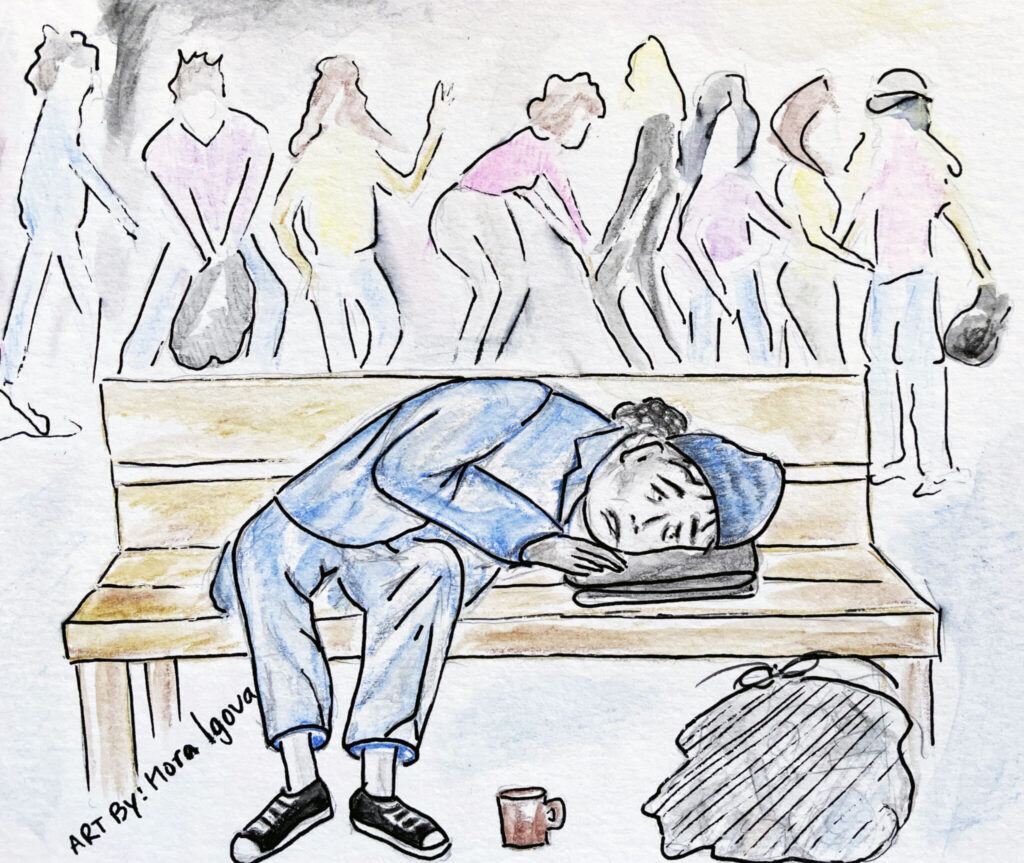
Choices and consequences along the difficult road to recovery
This article was originally published in The Angolite out of Louisiana State Penitentiary. It won third place for Best Long-Form Feature in the 2026 American Penal Press Contest.
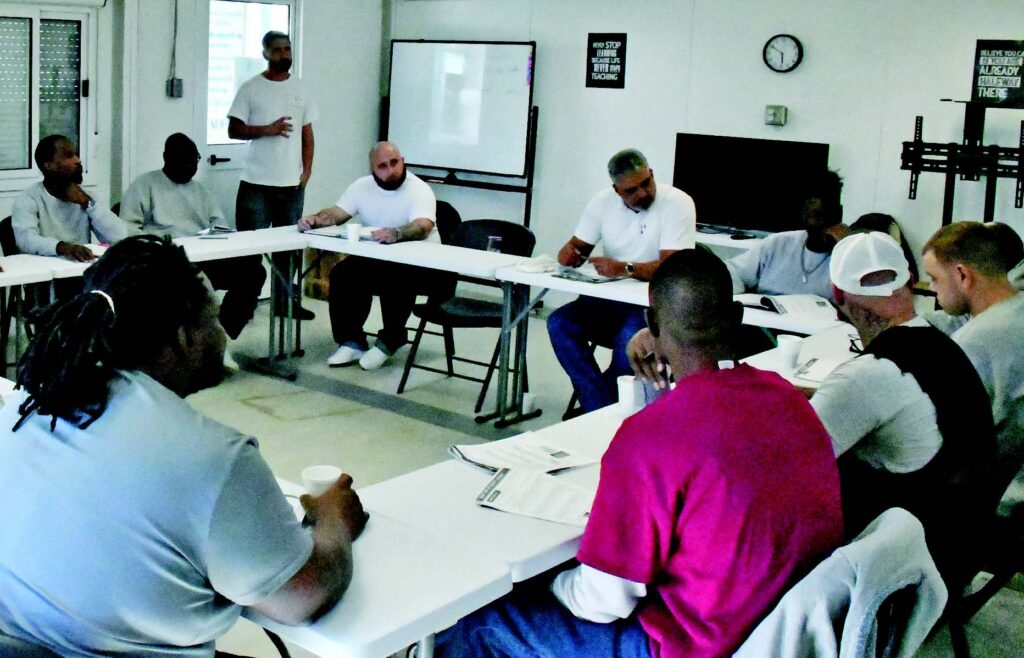
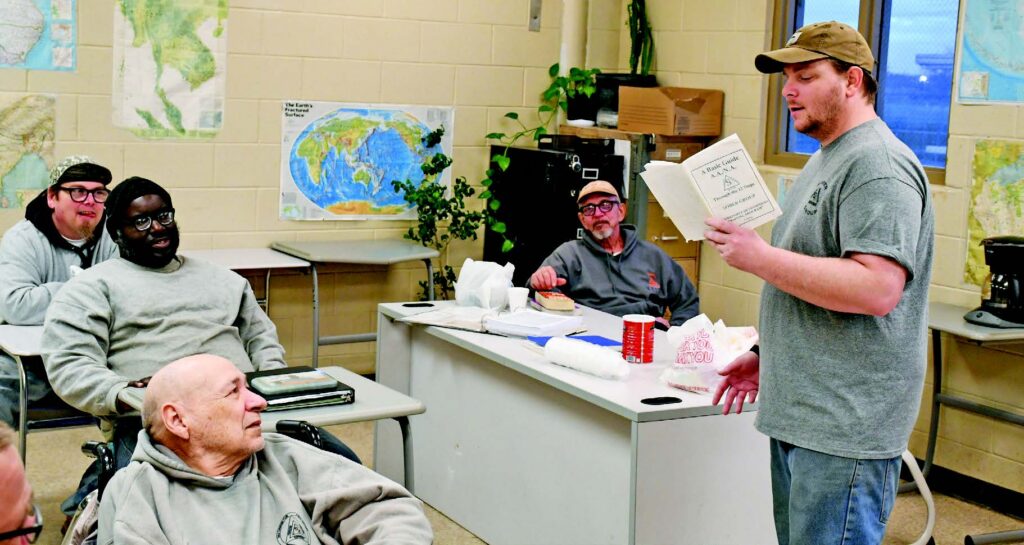
Twice a week, prisoners gather in a classroom in the main prison education building, filing in by ones and twos to sit in small desks and begin the session with donated, watered-down coffee. Written on the chalkboard is “Sober Group of A.A.,” and a list of the sobriety steps they will be discussing that night. It is a routine that has taken place at the Louisiana State Penitentiary at Angola for decades, in different rooms, on different nights, but the feeling is the same. For some, it is a place to be other than the dormitory. For others, it is a mandatory part of their drug rehabilitation plan. Some come to catch up with friends, some come because it is the only thing keeping them alive.
“Make sure you sign in,” announces the group’s facilitator, Wade Esteve. “If you don’t sign in, you’re not here. If you’re not here, you don’t get credit.”
“It’s supposed to be anonymous,” someone says. “Alcoholics Anonymous.”
Esteve shakes his head.
This is one of many classes offered each week to people suffering from the disease of addiction. It could be any other night, in any other place, from church basements to VFW halls to jails and prisons across America: addicts gathering together to discuss the unspoken trauma in their lives.
By its very nature, addiction is a disease that biologically undermines the addict. Medical experts agree that long-term addiction changes a person’s brain chemistry. It changes the way an addict sees the world. It interferes with the proper functioning of the prefrontal cortex, diminishing judgment. It makes it acceptable to commit acts one would never have considered before. Like theft or robbery, or shooting at the police.
“I was very badly inebriated. I had been up for seven days on meth. My judgment wasn’t the most sane,” Esteve said. “We were going to hit a score, some oxy. I was 19 and had just gotten back from Florida and was at my cousin’s house. We were cooking crystal meth and a buddy told me that he knew someone who had six strips of oxy.”
They decided steal a car to sell to a local buyer. During the attempt that followed, Esteve ended up in a high speed chase with police during which he fired a shot from a shotgun loaded with birdshot. The pellets hit the police cruiser, ricocheted off its hood, and struck the officer driving.
“I started smoking weed around the time I was five. I started smoking crack around 10, meth at 13. Two weeks before my 14th birthday, my dad went to prison.”
For those arriving in local lock-ups, there is often very little support beyond being given a place to lie down while awaiting their day in court. Federal Bureau of Justice Statistics (BJS) figures for 2019—the last full year the agency performed an assessment—revealed that of the more than 3,000 local jails across the country, less than two-thirds screened people for opioid use disorders, while only half provided medication to inmates experiencing withdrawal. More importantly, the most effective treatment for substance abuse—medication- assisted treatment (MAT)—is the least commonly available.
“When I got to jail, I detoxed for about a month, lying on a mat. People would wake me up and tell me I needed to eat or drink. That was the first time I’d ever actually sobered up.” In the parish jail, facing the seriousness of the charges against him, Esteve struggled with his sobriety and the consequences of addiction. “I really couldn’t deal with it, so I went to the psych doctor to get the mystery bag of pills. I didn’t want to deal with reality at that time, which led me right back into addiction because as soon as I got on my pills, I started trading and stockpiling just to put them all in a cup and melt them down to black out for awhile.”
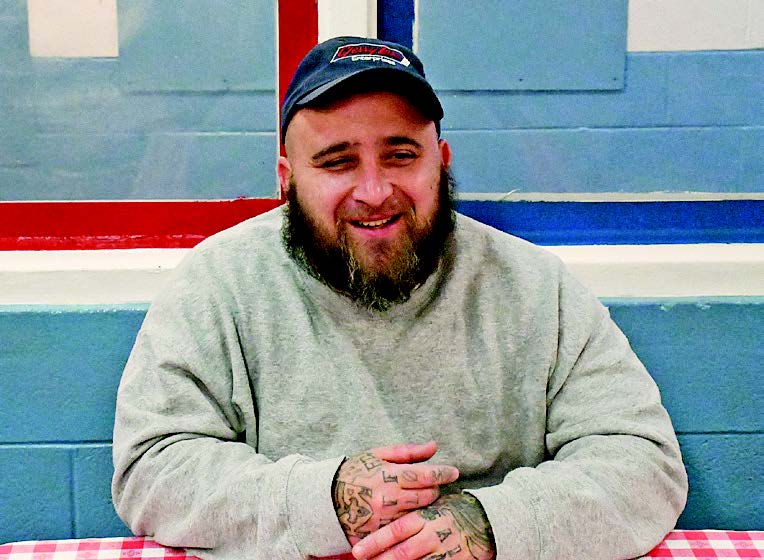
Esteve, 33, has now been incarcerated for 14 years. He began attending Alcoholic Anonymous meetings six years ago, becoming a group facilitator in 2023 for both Sober Group of A.A. and A.A. Each Day’s weekly sobriety classes.
With him is his father, 63-year-old Vernon Esteve, serving a life sentence as a multiple offender for the manufacture of methamphetamine. A lifelong addict, Vernon did not begin his own road to recovery until after his son followed him to prison.
“I’ve had an addiction problem all my life. Probably since I was about 10,” Vernon said. “I came from a broken family. My father was an alcoholic and drug addict.” It was a cycle he perpetuated with his own son, Wade. “I didn’t want to admit that I had a drug problem, so I couldn’t get help for a drug problem. It wasn’t until I saw Wade go through the New Men program, and he got straight, that I really took rehabilitation serious.”
The father-son duo works together now as part of Angola’s substance abuse and treatment matrix, a programming network that runs the gamut from weekly faith-based self-help groups, such as A.A. Each Day, Sober Group, and Celebrate Recovery, to peer-led residential programs that receive state sponsorship and institutional resources, like the Behavioral Management, Corrections Court Reentry, and New Men Intensive Sobriety programs; as well as the Substance Treatment and Recovery (STR) program, the facility’s lone MAT option for addicts.
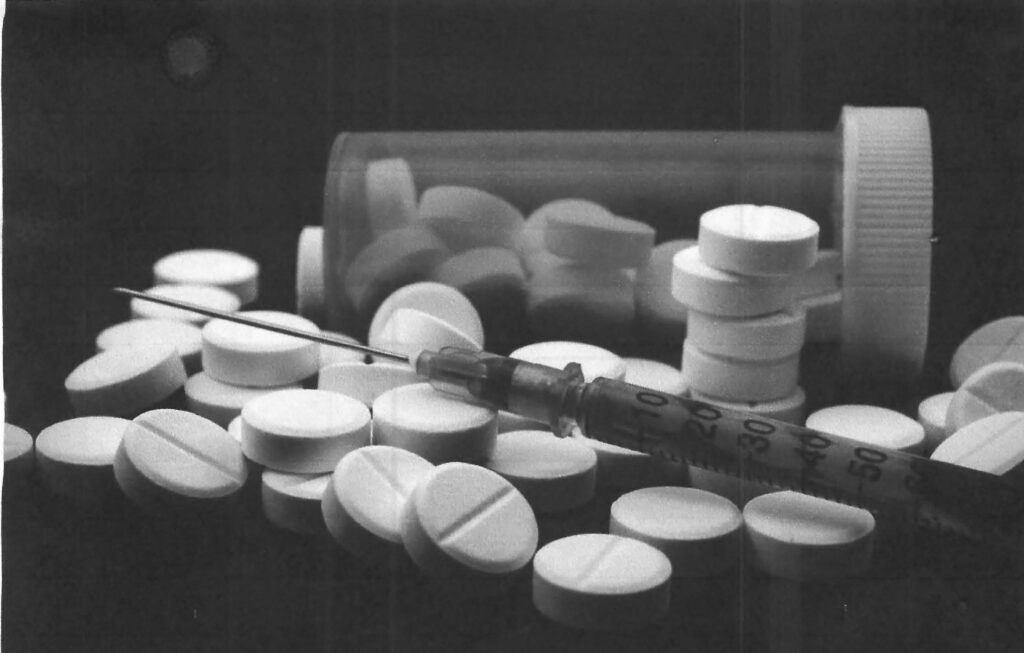
America has always had a problem with addiction and its prisons are filled with the casualties of the fruitless War on Drugs. For every high-profile drug kingpin captured and successfully prosecuted, thousands of average people deal with the consequences of damaged and destroyed lives due to addiction. By early 2024, according to the National Survey of Drug Use and Health, nearly 48 million Americans over the age of 12 suffered from substance abuse disorders involving drugs, alcohol, or both.
Experts tracked the trend to the 1990s, beginning with the widespread use of opioid painkillers aggressively marketed to the public by big pharma, with brands such as Purdue Pharma’s OxyContin driving an ever-increasing demand. What followed were waves of fatalities, leading up to America’s deadly love affair with fentanyl. Between 2014 and 2021, as fentanyl entered the U.S. marketplace, death rates across the country exploded. Synthetic opioids—a class of drugs that also includes buprenophine, methadone, and oxycodone— accounted for fewer than three thousand overdose deaths in 2013. Last year, that number grew to more than 81,000.
It is a damning statistic for opioids alone, one that has driven the overall surge of drug-induced deaths for more than three decades. In 1982, at the beginning of the national panic over crack cocaine, the U.S. Center for Disease Control and Prevention (CDC) officially recorded 6,299 total overdose deaths in the U.S. In 2023, that number had increased over 16 times to 107,543.
“This is a different kind of crisis, and it’s not going to go away as quickly,” said Dr. Joshua Sharfstein in a 2021 report. A health policy expert at the John Hopkins Bloomberg School of Public Health in Baltimore, Sharfstein tracked the rise of drug-related deaths that were masked by the worldwide COVID-19 pandemic. “During the pandemic, a lot of (drug) programs weren’t able to operate. Street-level outreach was very difficult. People were very isolated.”
But isolation alone did not drive the rise in deaths. “The type of drugs that are available now are much more dangerous,” said Dr. Nora Volkow, director of the National Institute of Drug Abuse. To increase profits, drug suppliers began to mix cheap fentanyl with cocaine and methamphetamine. It was a mixture that boosted their effects, but also their lethality.
In 2020, the National Center for Health Statistics, reported that overdose deaths totaled 93,000, an increase of 30 percent from the preceding year. In 2021, overdose deaths crossed a deadly milestone, passing the 100,000 mark for the first time in the country’s history. Closing the national borders did not stop the flow of fentanyl, Volkow said. During COVID, it accelerated.
In Louisiana, addicts were not fairing much better. In fact, Louisianans were doing much worse. Beginning in 2015, records produced by the East Baton Rouge District Attorney’s Office showed that the state correlated with national statistics for overdose deaths—averaging a few points above—until midway through 2019. That year, Louisiana took a dramatic turn, with overdose deaths skyrocketing in a steady rise, nearing 60 per 100,000 people by 2021, almost double the national average.
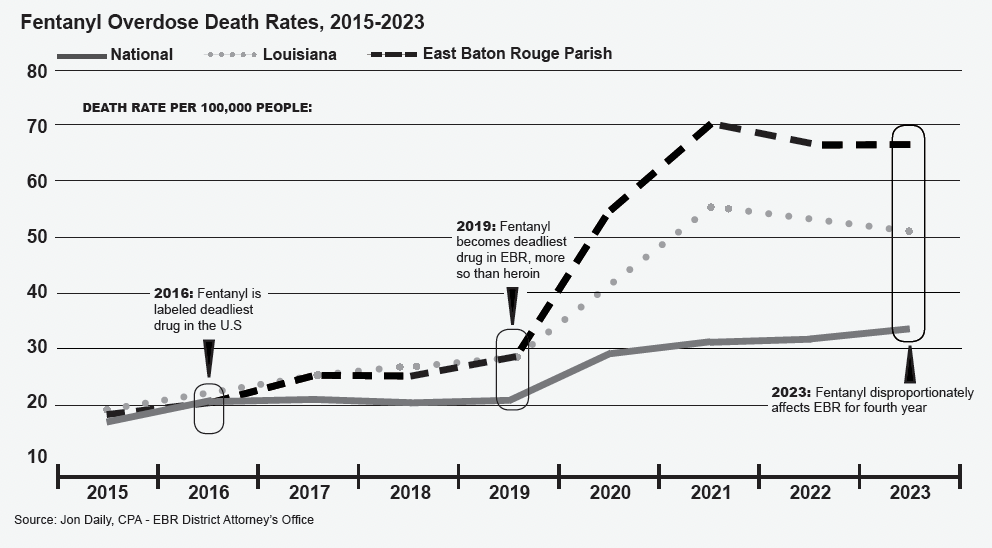
Drug deaths in East Baton Rouge Parish, wherein lies the state capital located some 60 miles to the south of Angola, nearly doubled from 126 to 242 in 2020, followed by a record high of 311 in 2021.
By 2023, as the pandemic receded and communities re-opened as if recovering from a long storm, the Louisiana Opioid Data and Surveillance System, part of the Louisiana Department of Health, reported 2,456 drug-related deaths statewide for the year—nearly half of which resulted from opioids. The cost, beyond that of lives lost, was economic as well, with overdoses requiring 13,937 drug-poisoning emergency room visits.
As the rest of the world goes, so goes the world behind bars, and what may be marginalized to the edges and shadows of outside communities is concentrated in prison. Behind bars, it is the community itself.
Prisons are islands, isolated realms whose inhabitants spend their days secluded from the rest of the world. The only physical contact most prisoners have with those outside—beyond the administrative, correctional, and medical officers who work behind the fences—come from rare family visits, volunteer prison ministries, or the occasional tour of dignitaries or school children paraded along well-swept and painted walkways signifying the orderly and cleansing spirit of rehabilitation. As with an island, nothing arrives in prison unless it’s brought there, and once there, a thing rarely leaves—like the flu, like COVID, like fentanyl.
Lock-ups have always had their problems with contraband, whether alcohol, drugs, cellphones, porn or any other prohibited material. Inmates are a ripe market for exploitation by those looking to make a huge profit. Introduced by inmates themselves or smuggled in with the help of correctional employees, contraband will always supply a thriving market. Those arriving in jail bring their troubles with them and, when untreated, those troubles are carried to the prisons where they pass the days they are sentenced to.
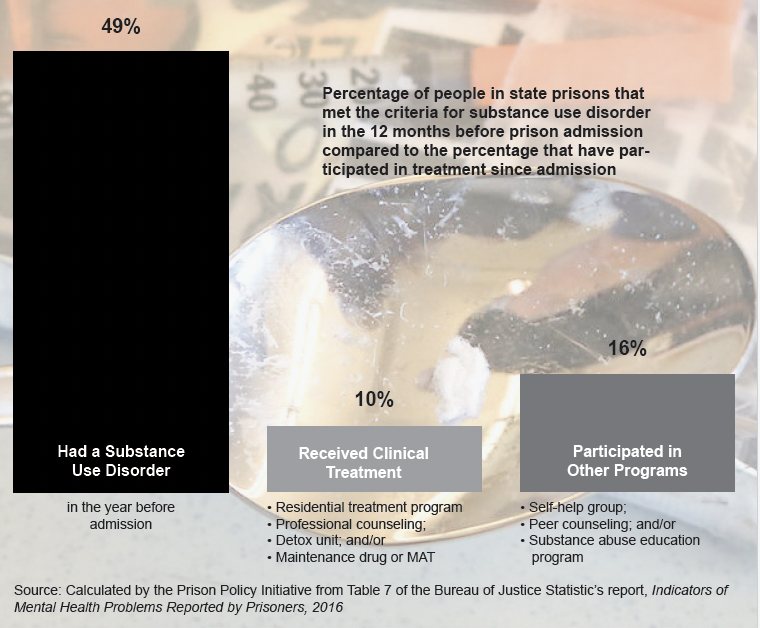
A 2024 report by the Prison Policy Initiative estimated that while only 8 percent of people nationally met the criteria for a substance abuse disorder in 2019, such disorders were far more common for people arrested (41 percent) and people incarcerated in federal (32 percent) or state prisons (49 percent). Of the more than 2.3 million people incarcerated in America’s federal and state prisons, local jails, juvenile correctional facilities, and immigration centers, 1 in 5 are locked up for drug offenses.
“Just as punitive responses to drugs have driven incarceration, substantial evidence suggests that incarceration is associated with increased risk of overdose,” reported the Brooklyn-based VERA Institute of Justice. “Research has confirmed that overdose is the leading cause of death among recently released prisoners, as well as the third leading cause of deaths in custody in U.S. jails.”
Reflecting the evidence, the Louisiana Incarceration Transparency Project documented 1,168 total deaths for individuals housed in the state’s prisons, jails, and youth detention centers between 2015 and 2021. The project, a database that provides facility- level deaths behind bars data and analysis for the state, is run by Professor Andrea Armstrong at Loyola University New Orleans College of Law.
Of the total number of deaths recorded by the project, 81 percent were attributed to medical—or, natural—causes, with heart disease and cancer as the primary cause. Suicides ranked second at 6 percent, followed by drug overdoses at 5 percent.
Parish jails had the largest share of unnatural deaths. Over 61 percent of suicides occurred in parish jails, compared to 29 percent in state prisons. For drug-related deaths, almost 54 percent occurred parish jails.
“Louisiana is relatively unique in the U.S. for using local jails to house approximately 50 percent of people serving their state sentence in a local jail. Jails are traditionally operated by local sheriffs and are primarily for people detained pretrial. They are designed for shortterm housing and therefore often lack more robust services essential for people serving long-term sentences, including appropriate health care, recidivism prevention programming, and skills training,” Armstrong wrote. “Prisons, on the other hand, are operated by the state and are primarily for people serving a judicially determined sentence after being convicted of a crime. As a result of this bifurcated system, the DPS&C prioritizes state prison beds for people with longer sentences or serious health needs. Local jails and private operators house the remaining state population of 50 percent, in addition to their traditional pretrial populations.”
Incarceration Transparency found that drug overdoses where highest in 2021, accounting for 11.29 percent of that year’s 193 total deaths, outpacing suicides at 8 percent. This was a COVID year when, within prisons, visitation was suspended, rehabilitational programming was canceled, and inmates were restricted in their movements. The report warned that its findings were merely a “snapshot of known deaths behind bars,” as some facilities that were sent Freedom Of Information Act requests either did not respond, had no records to provide, or obscured actual causes of deaths.
In some cases, deaths may have been coded “medical” by a facility, but drugs may have precipitated the medical condition that caused the death. “It is important to note that several categories of death may be interrelated,” Armstrong said. “For example, a person’s cause of death may be recorded as accidental, suicide, or violent; however, in some cases, advocates report that drugs may have played a role in those deaths as well.”
Identifying a prisoner’s cause of death is often a game of hit-or-miss, as most states break reporting laws. Louisiana’s Department of Public Safety & Corrections (DPS&C) officially reported 148 deaths in 2023, but experts such as Armstrong argue that the actual numbers are probably higher.
A March 2022 report in The Appeal by researchers at the University of North Carolina revealed that in 2021 the BJS—the agency at the Department of Justice (DOJ) responsible for collecting data on deaths of incarcerated people under the Death in Custody Reporting Act (DCRA) of 2000—quietly terminated its data collecting entirely, announcing that from 2000 to 2019, an average of 81 percent of jail jurisdictions in the U.S. reported no deaths.
The report found that policies on reporting deaths varied significantly across prison systems, with only 15 states mandating that deaths in custody be reported to either a court or prosecutor. Only two states, Massachusetts and Texas, required correctional facilities to report in-custody deaths directly to the U.S. Attorney General and the DOJ per DCRA rules. Louisiana was found to not be in compliance with any provision of DCRA, failing to consistently report in-custodial deaths. “Twenty-eight systems issue press releases when an incarcerated person dies. Still, the frequency of press releases in states such as Louisiana, Mississippi, and Montana did not match the number of deaths reported in statistical publications.”
“The way that I frame it is that we know that at least 1,168 people died behind bars since 2015 to 2021 in Louisiana. But that’s at least a minimum,” Armstrong said. “I am confident that there are deaths that have occurred that are not included in our database.”
According to available data, the penitentiary at Angola logged 19 overdose deaths in 2023. For 2024, following an overall drop in overdose deaths across the country, the facility lost 12 inmates. When overdose deaths occur, one suspect is always fentanyl.
A synthetic opioid mixed from precursor chemicals, most of which are manufactured and shipped from China, fentanyl is 50 times more powerful than heroin, 100 times more than morphine. Classified as a Schedule II drug under federal guidelines, it is tightly regulated. When used properly, it may be prescribed for pain in extremely small doses. Illicit, unregulated “street” fentanyl is a death sentence, particularly when mixed with other drugs, such as cocaine, and sold to unaware users.
An overdose occurs when a toxic amount of a drug or combination of drugs overwhelms the body. Opioid overdoses happen when there are so many opioids or combinations of opioids that the body is not responsive to stimulation, or when breathing becomes inadequate. Most commonly, respiratory failure ensues, leading to death.
By 2016, fentanyl was labeled as the deadliest drug in America. To counter the rising death toll, Emergent BioSolutions Inc. released naloxone. Marketed as Narcan, naloxone hydrochloride is used to reverse opioid overdose. Referred to as the “Lazarus drug,” Narcan became available as an over the counter (OTC) nasal spray with FDA approval in 2023.
A non-scheduled (non-addictive) medication, naloxone cancels out the life-threatening depression of the central nervous and respiratory systems due to opioid overdose. An effective feature of the OTC medication is that it may be administered by non-medical personnel and only works where opioids are present. Often requiring multiple doses to take effect, there is no risk to an overdose victim.
Even with the lifesaving benefits of naloxone—which experts credit with the sharp decline in overdose deaths over the past two years—the drug does not treat addiction. However, it can be used in conjunction with other drugs to decrease the severity of withdrawal symptoms and reduce an addict’s dependence on opioids long-term as part of a MAT program.
Medication-assisted treatment may be accomplished with a variety of medications, primarily buprenorphine, methadone, and naloxone, a family of drugs called opioid antagonists that counteract what is known as the “opioid effect.” When an addict uses an opioid, the drug activates a pain-blocking receptor in the brain, releasing endorphins that mimic pleasure. Opioid antagonists like Suboxone (buprenorphine/naloxone) negate the effects of opioids, preventing them from activating those receptors.
In treating addiction issues, “a wealth of strong evidence shows that medication is by far the most effective approach,” reported John Hopkins Dr. Emma McGinty. But the use of medically assisted treatment has its detractors, due both to costs and the perceived stigma surrounding the use of addictive treatments like methadone. McGinty said this reveals “longstanding misconceptions and negative biases about medication for OUD (opioid use disorder)—for example, the incorrect idea that it replaces one addiction with another.”
The debate over MATs is reflected by their scarcity of use within carceral settings. These programs represent the least common form of addiction treatment in prisons. According to the reform advocacy group Prison Policy Initiative, fewer than 10 percent of incarcerated people suffering substance abuse disorders are offered medical assistance for withdrawal or addiction symptoms at any point. For most prisoners, drug and alcohol programming is primarily self-help or peer-based, with incidences of drug use or overdose treated with punitive, disciplinary measures that do little to address underlying treatment needs.
The Louisiana DPS&C operates three Residential Substance Abuse Treatment (RSAT) programs where MAT may be distributed to inmates suffering from a substance abuse disorder (SUD). The 600-bed Steve Hoyle Intensive Substance Abuse Program at the Bossier Parish Correctional Center; a 40-bed program operated at the Concordia Parish Correctional Center; and at Angola, as part of the facility’s Substance Treatment and Recovery (STR) program.
A quiet little initiative that meets in the Main Prison Education Building, STR generally revolves around an individual’s release date. “We actually look for individuals with maybe two years coming up to a parole hearing, or being released. That is the focus, 18 months to two years,” coordinator Lori Stone said. “That is just the basic requirement. Individuals who have had a problem, some still have a problem.”
The 9-month STR operates in small group settings of less than 15 participants, meeting four times a week for counseling sessions, utilizing New Directions—a series of workbooks created by the Minnesota Department of Corrections in 2019. Individuals entering the program are assessed using the Targeted Interventions Gaining Enhanced Reentry (TIGER) model. Participants complete a biopsychosocial assessment and are given the Michigan Alcoholism Screening Test (MAST) and Drug Abuse Screening Test (DAST) to assess them for alcohol and substance abuse disorders.
“One of the things I find out once I do an intake and gather their background information is, some of these guys suffering addiction have never been to treatment before,” Stone said. “So, we do an introduction explaining the guidelines. We do socialization, criminal addictive thinking, criminal addictive behavior, relapse prevention, release, and reintegration.”
A certified recovery peer support specialist who is also a recovering addict, Stone has conducted substance abuse and recovery programming for the DPS&C for 12 years. “August 10, 1992, is my sobriety date. One of the things I’ve found out through this travel is, it’s for those who want it, not need it. What can you do if a person doesn’t want treatment? It’s my responsibility as an individual who uses the 12-step program (A.A.) just to talk the message. If they want it, they’ll get it. Even if they don’t, at least they’ll know where to go when they’re ready.”
Participants who are ready—or who may be court-ordered to participate in a treatment program—are offered the choice of either STR’s group counseling sessions alone, or in conjunction with medical assistance.
Alfred Bankston self-enrolled in STR to address patterns of negative behavior that had plagued his life. “I felt like I needed to improve myself. I wanted to learn some things about myself.” Incarcerated at Angola for 27 years, Bankston said he never suffered from issues related to addiction. “I smoked weed, but I never did opioids or meth. But what the program did for me was address my criminal behavior. Smoking weed, for me, was part of my criminal addictive behavior.”
Prior to entering STR, Bankston attended other faith-based sobriety programs, including nightly meetings with Sober Group, but credits STR with his growth. “STR really dug in. It made me go all the way in deep to past experiences, those hard past experiences, and it dug all that out and made me face stuff. It made me recognize my triggers, and from there, I’m able to start healing.”
Stone said the half of the program’s success is in attending to participants’ underlying emotional and psychological issues that are often masked by substance abuse. “They don’t have a lot of tools in their toolbox. So, the program that we have, we give it all to them.” Beyond STR’s core New Directions curriculum, the group may also participate in art therapy, journaling, and trauma healing focused on childhood trauma. “A lot of this stuff starts at an early age and one of the things about being a facilitator and a peer who experienced trauma as a child, knowing what real abuse is, the curriculum we have really allows you to get in touch with yourself. To be open and honest in addressing things. So, the therapeutic community we create in this group setting, we are touching on everything. You’re not just going to sit here and say, ‘No, I’m good.’ We’re not always good.”
As a MAT program, STR also provides Naltrexone. A pill version of the more expensive Vivitrol injection, Naltrexone’s primary focus deals with opioids. “It’s a blocker, you can’t get high,” Stone said. But for those suffering severe addiction, “it decreases cravings, so you don’t want it anymore.” Dispensed through standard pill-call procedures as a “keep-on-person” medication, STR graduates may continue receiving the medication for as long as requested, or until released from prison. Prior to release, individuals may then receive a Vivitrol injection which provides an extended release of Naltrexone for up to 30 days.
“One of the things about the shot is that it is around $1,200, so we have to be cost efficient while someone here is in treatment. But the pill is so different from Suboxone or methadone, in that you can’t get high on it. We provide the shot to those leaving to carry them until they can be connected with outside treatment to continue their care.”
The program boasts a completion rate of 98 percent, with graduates tracked for two years through follow-up interviews. Tracking includes checks on their mental health status, substance abuse relapses and “what’s going on with them, what’s changed, and what can we do to continue help?” Stone said. A MAT program that includes a carefully-monitored medication regime, substance abuse counseling, and regular primary care increases an addict’s success rate by 50 percent. “It keeps them engaged and connected to a very adequate support system.”
Critics of MAT programs disagree, declaring them little more than drug substitutes that continue an addiction rather than cure it. Prison and jail administrators are wary of such programs in their facilities citing cost and the contraband diversion of medications, especially in programs utilizing buprenorphine or methadone. Inmates themselves often refuse MAT-based treatment, preferring abstinence-based counseling over pills or injections.
Vernon Esteve agreed. “I wouldn’t want to medicate. For me, it was time to say enough is enough and to stop. I work with my higher power. Until you decide, deep down in your heart, that you don’t want this anymore and you’re going to fight it, that’s the only way you’re going to stop.”
Given the lack of MAT program availability, abstinence, willpower, and faith in a higher power are all that remain for many. Outside of the fewer than 20 individuals who successfully gain entrance to STR each year, Angola’s addicted population exists within a wasteland, concentrated in overcrowded dorms or locked on cellblocks watched over by skeleton crews of correctional staff—a condition that necessitated the growth of alternative treatment programs created by the addicts themselves.
By early 2015, Angola was awash with a new, nearly undetectable form of high with the introduction of synthetic marijuana. Commonly referred to as “Mojo,” the term came to imply anything that was sprayed onto a piece of paper and smoked. Soon, inmates began making their own versions of the drug from available agricultural and cleaning supplies. These versions not as effective towards attaining a high, but were every bit as deadly as what arrived from outside the prison’s gates. Between the synthetic marijuana, bootleg mojo, and fentanyl-laced drugs introduced into the inmate population, the prison’s correctional and medical staff were virtually overwhelmed. Cellblocks became a dumping ground for the chemically addicted and entire dormitory units were written off as unmanageable by a staff that has transitioned over the last 20 years from nearly all male to all female in what was once known as the country’s bloodiest prison.
To address increasing incidences of overdose and violence, inmate self-help organizations, which have always been a part of the penitentiary culture, were revitalized with a focus toward substance abuse. Inmate leaders stepped up to condemn the violence and loss of life. New programs and events were designed to provide the incarcerated population with healthy activities.
In 2020, the faith-based New Men Intensive Sobriety program— mirroring RSAT models—was established on the Main Prison West Yard. Sidelined during the early months of the pandemic, the program was reborn with renewed urgency following the explosive growth of fentanyl- laced narcotics and rising death rates in the penitentiary. Centralized in a West Yard dormitory, addicted prisoners finally began to move into the program in October 2020, along with inmate peer supporters. A non-MAT program, New Men leans heavily towards faith-based Christian programming.
Mentees are restricted during Phase I to Walnut-4 dormitory for the first 90 days, where they receive counseling classes from live-in New Men mentors. Upon graduation to Phase II, mentees move to Walnut-3 for 90 days, where they continue both faith-based and nonfaith-based sobriety programming. Phase II mentees gain limited movement to attend other classes or events outside of the dorm, accompanied by a mentor.
As part of the sobriety program’s Christian model, both mentees and mentors may be counseled or removed from the program for contraband, drug use, or offenses as minor as the use of foul language. And while not specifically prohibited by the program’s policies, secular music, literature, and non-Christ-centered televison shows and movies are frowned upon. Both mentees and mentors are expected to participate in Bible studies and other religious programming.
Mentees who complete the six months of programming are offered the opportunity to remain with New Men in “aftercare.” Graduates may opt to live on the West Yard as part of the cadre of inmates who help the program run—from trash men to yard orderlies, dorm maintenance and painters, to facilitator/instructors and mentors. Those who choose to leave are returned to general population.
A novel idea, the New Men program has served for just over four years as an experiment in self-policing: a faith-based, peer-led inmate community with the mission of combating the scourge of drug addiction and its attendant ills.
“I believe that this is a form of demon possession,” James Martin said. “That’s the perspective I take and it works for me.” A graduate of New Men, Martin failed twice in early attempts to complete the program. “With meth, with drugs that have a physical withdrawal like heroin, there comes a fear of the withdrawal. The fear is more paralyzing than the withdrawal itself.”
Martin decided to remain with New Men for over a year after graduating, working for the program as a painter and orderly, while also facilitating classes and Bible studies for other graduates and Phase II mentees. Eventually he left the West Yard for the East Yard in 2024. He remains sober, participating in the weekly A.A. classes held in the Education Building. “The easiest way to deal with this problem is, if you get an intoxication, you go on record and they prescribe you Suboxone. That would be the easiest way, but is that going to totally eliminate the problem? It only works for dope and it’s not a solution in and of itself because then you’re stuck with a massive Suboxone problem. It’s a moral-spiritual dilemma, and for me, it can only be approached as such.”
Critics of faith-based programs cite their coercive nature and the possibility of ostracizing members of different faith groups, denying them the opportunity for treatment. Experts also warn of the illusion of temporary sobriety that does not adequately address the underlying biophysical aspects of addiction but portrays the disease as a moral failure noting that, when an addict has wrestled with addiction for many years, a brief period of detox and counseling may provide temporary relief but is often unsuccessful in the long-term.
“And that’s because there is not an understanding of the brain disease versus just physical dependency,” said Linda Hurley, president and CEO of CODAC Behavioral Healthcare. Hurley, whose company partners with the Rhode Island Department of Corrections, advocates for treating people medically, even those who have already gone through withdrawal, even if they won’t be released for decades—a concept called “early induction.”
Because addiction is recognized as a disease, Hurley said, sufferers have the right to medically-assisted treatment under the Americans with Disabilities Act, “like any other medication, for any other disease.”
Inmate-led abstinence programs are popular with many prison administrators because they are seemingly cost-efficient. It costs very little for Angola to support a program like New Men, which utilizes few resources beyond a pre-existing dormitory. Inmate mentors with few to no qualifications as drug counselors— except a history of addiction—are far cheaper than professional certified addiction counselors. But a desire to cut costs in a battle to curb addiction usually ends up costing more.
“Any [faith-based] type program is a spiritual program that gives you the opportunity to have and find a higher power of your choice, but everyone doesn’t have the same higher power. Some people just don’t believe, but they do recover,” Stone said. “I used to be a stickler for no drugs, you just remain sober. But then again, going down this road, we’re just trying to save a life. Just like if you go to the doctor and he prescribes you something that’s going to help you. So why not have the Naltrexone pill? Why not the Vivitrol shot? Or try Suboxone or methadone, because everyone is different. There’s no one size, cookie-cutter fix that’s going to be for everyone.”
Statistics for the New Men program are subject to interpretation. Since 2020, the program has admitted 341 participants with 204 successfully completing. Tracking the graduates after release—a difficult and spotty proposition with inmates being transferred to other units within the prison, and to other facilities—New Men claims a sobriety success rate of 16 percent, higher than the statistical average for drug rehabilitation programs.
New Men mentor Trevor Reese agreed with the value MAT can add to drug rehab but acknowledged such treatment options in the prison are few. “I think this is the only working model here (New Men), because Christians have this evangelical mission. They are going to support and throw money behind this kind of treatment. Right now, faith-based seems to be our only option because they don’t seem to be interested in any other options.”
“I pretty much grew up in a family where everybody did drugs, drank, party people, stuff like that.” Dylan Magluilo was born in Houston but grew up in Shreveport. By the time he was nine, he had discovered cigarettes and marijuana, selling nickel bags of weed for money. At 10, he was kicked out of his home and taken in by others in the community, mostly drug dealers, until virtually adopted by a family to get him off the street. At 13, he was told by “Mrs. Ruby”—who he called “Mom”—that he needed to return home to his actual mother. Before leaving, he fell into an altercation with his stepfather, an alcoholic, who placed his hands on him. A 13-year-old Dylan knocked him out.
Initially charged for the assault, Dylan was placed in Johnny Gray Jones youth group home in Bossier Parish, until the charges were dropped and he was turned over to the state’s Social Services Department. When his mother refused to take him, he was sent to live with his grandmother in Longview, Texas, where he met people who cooked methamphetamine.
“When I was 13, I got introduced to meth and every other drug known to man. That was the beginning,” Dylan said. “They weren’t very sociable people but I was.” Reaching an agreement to become their dealer, Dylan would get the drug for free, turning it into a lifestyle. “I was just corrupted by every community I stepped into.”
Eventually returning to Shreveport, he was arrested for drug dealing in 2015. He bonded out, but was arrested again that same month for murder. He arrived at Angola in 2017 with a life sentence. Once processed in and settled, he set about living life as he always had.
“It was the same way as it had been on the streets. I had made this way where I had drugs, so I always felt good.” Never a needle user on the street, Dylan graduated from marijuana and meth to heroin. “I never looked at myself as a junkie. I thought, ‘I’m straight. I do my little hustling but I keep myself together—I’m not selling my stuff, turning tricks, selling my body, or whatever. I just made a little money, was supporting myself, and getting high at the same time.’”
Living on the West Yard in Hickory 2, Dylan was asked by a friend to attend an orientation for New Men but he refused the program. “I felt like I was making it,” he said. “I had a phone, Jordans on. A typical Angola drug dealer. And that was my mind-set but I was really bad off. I was on the verge of getting myself killed because I was doing all kinds of crazy stuff. I was losing my mind.”
In 2020, caught with meth and a cellphone, he was placed in the working cellblocks where he maintained for nearly a year without a disciplinary report. Still, officials refused to let him out of the blocks. “Col. [Larry] Simon refused to release me. I admitted I had a drug problem but he felt like I was just trying to use New Men up to get out of the cell.” Shortly thereafter, he was involved in a stabbing which sent him further down the hole to administrative lockdown. There, he returned to selling drugs, and began using again.
“I got to the point where I beat myself down so badly I was unrecognizable. I could see it affecting other people,” Dylan said. “Dudes would walk by my cell and cry, and these were guys I know that, their own brother had just died and they didn’t cry. But they’re crying for me and I’m just someone they met in Angola. This is a killer looking at me and he’s crying because I’m so ripped. I realized I had messed all my relationships up.”
Dylan wasted away for over two years until finally beginning the process of programming, working back through rehabilitational programs offered at Camp-C to make it to the West Yard and into New Men. Offered a second chance to participate, he accepted.
“How much does it take? How far down do you have to go till you can’t go no lower than you’ve already been? I don’t know what it takes but I know this, it’s not the program,” Dylan said. “The program is here to help. You’ll get what you want out of it. The amount of energy you put into it, that’s what you’re going to get. But you have to make that choice that you sincerely want to change and I believe that only comes from a humbling moment, that humbling experience, that brokenness.”
In early 2024, the CDC reported that for the first time since 2018, U.S. overdose deaths decreased. Narcotics researchers say the widespread availability of naloxone appears to be the main factor in the sharp decline in synthetic overdose deaths over the past year. In the 12 months through July 2024, deaths fell 22 percent in the U.S. from the same period a year earlier.
Since 2021, the CDC estimates about 280,000 people have fatally overdosed in the U.S., a rate of 54.5 per 100,000 residents, two and a half times the national homicide rate of 19.8 per 100,000. In America, in relation to the number of lives lost, families traumatized, and communities destroyed, it is addiction and the criminalization of the disease of addiction versus treatment that is the real killer.
“A.A. Each Day averages a core group of around 15 guys who I’m going to see every Thursday and Saturday. Then we have guys who just show up because it is open to everyone,” said club president Cleveland Lawson. Lawson became involved with addiction counseling to help manage his own substance abuse issues. He sees A.A.’s mission as trying to fill the void for aftercare, from programs like STR and New Men, working in conjunction with Sober Group to provide a safe space for those who are in recovery, or still struggling.
“I try to catch them and bring them in so that they don’t relapse. Aftercare is a big part,” Lawson said. “Going through programs is good because when you’re in them, you’re not going to use. The test comes when you leave. You ain’t got nobody looking over your back and walking with you. We want to fill the void and give them a place to feel safe. We try to make a place for them, with all of us working together, so that we actually have a date open every day—regardless of what group or who’s sponsoring it—that there is an A.A./N.A. meeting.”
The battle is always uphill, though, with programs like STR and New Men reaching only a fraction of the more than 3,900 inmates housed in the penitentiary, more than 40 percent of whom statistics estimate suffer some form of addiction.
“People feel like there’s no hope and when there’s no hope, they try to live outside of that. Any way they think they can feel a little comfort, that’s where they are going to go,” Lawson said. “And the stuff they have now, they just don’t realize that it’s killing them.”
To support the ongoing battle being fought every day, volunteer A.A./N.A. members from Baton Rouge and Zachary drive to the prison, alternating every other week. Lawson attempts to bring both groups together every six months to hold a larger meeting. His goal is to bring members of all the sobriety support groups—A.A. Each Day, New Men, Sober Group, and STR—together with every outside volunteer group, to meet and find ways to work together.
“We’ve got to start building hope for people. Addiction isn’t really the problem, there’s something else they’re trying to run from. We have to figure out what your problem is, and everyone is different. If we can catch one, we’re good. We know we can’t catch everyone. If we can just reach one, then we’re good, because that one might actually reach someone else,” Lawson said. “So we just try and keep the door open for them.”